Mellifont Abbey was Ireland's first Cistercian monastery, founded in 1142 by Saint Malachy, Archbishop of Armagh.
It stands beside the River Mattock about 10 km (6 miles) north of Drogheda and only a short drive from Monasterboice,
making it an easy stop on a Boyne Valley day.
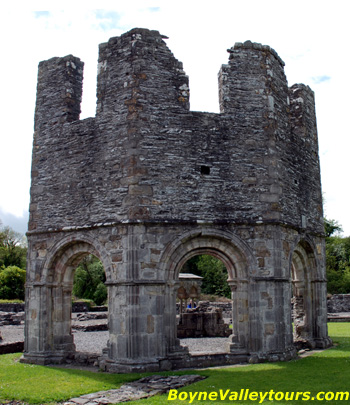
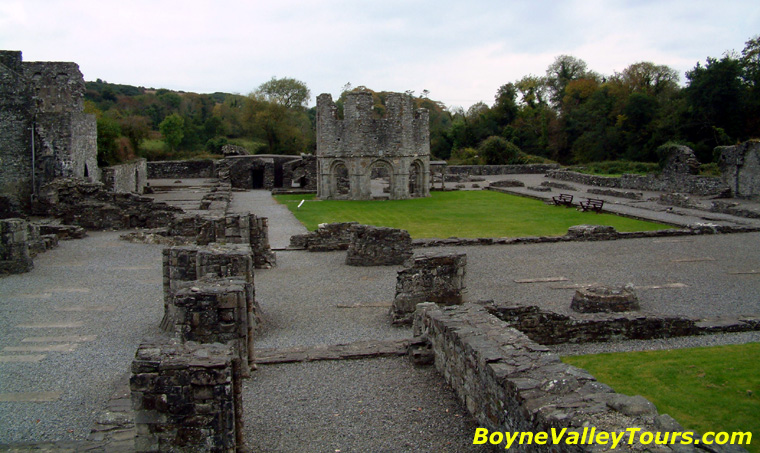
The octagonal lavabo at Mellifont Abbey.
The community grew quickly. By 1170 there were about one hundred monks and three hundred lay brothers.
Mellifont set the pattern for later Cistercian houses in Ireland, built in the formal French style of the order.
Nearby Bective Abbey, founded in 1147 on the River Boyne, was one of those daughter houses.
Local rulers helped the abbey get started. Donnachadh O'Carroll gave the land and building materials.
Muirchertach O'Loughlin, king of Ulster, gave cattle and gold.
Derbforgaill, wife of Tiernan O'Rourke, gave gold, a chalice, and the altar cloths.
Henry VIII closed Mellifont in 1539 when he suppressed the monasteries and handed their lands to political supporters.
By 1603, when the Treaty of Mellifont was signed here between the English Crown and Hugh O'Neill, Earl of Tyrone, the site had become a fortified house belonging to Garret Moore, a friend of O'Neill.
William of Orange later used Mellifont Abbey House as his headquarters during the Battle of the Boyne in 1690.
Little of the original abbey survives, but the setting is still atmospheric. The standout feature is the 13th century lavabo, an elegant stone pavilion where the monks washed their hands before meals.
Designed for visitors who enjoy medieval history, atmospheric ruins, and photography, this private Boyne Valley tour explores castles, abbeys, and early Christian monuments.
Stops include Ireland's largest Anglo-Norman fortress at Trim Castle,
the monastic ruins of Mellifont Abbey and Bective Abbey,
and the high crosses at Monasterboice.
The day can also include the Hill of Slane and Slane Castle when available.
Price €700 for up to six guests, plus booking fees. Admission fees are extra.
In 1140 Saint Malachy, then bishop of Down and formerly Archbishop of Armagh, was traveling to Rome.
Drawn by the fame of Saint Bernard, he visited Clairvaux and was so impressed that he asked the Pope for leave to resign and enter the monastery as a novice.
Permission was refused, but on the journey home he left companions at Clairvaux to train as Cistercians, with the aim of founding a monastery of the order in Ireland.
Malachy chose a site about 10 km (6 miles) north of Drogheda in County Louth, on land given by Donnachadh O'Carroll, who also supplied materials for the new abbey.
The first monks arrived in 1142: Irish men trained by Saint Bernard, together with French monks who directed the building.
Work paused over disagreements about the French design, then resumed after Bernard and Malachy settled the dispute, and the abbey was completed in 1157.
Malachy himself never saw the finished house. On another journey to Rome in 1148 he fell ill at Clairvaux and died there on 2 November, in the care of Saint Bernard.
The Norman Invasion
Within thirty years of Mellifont's foundation, a Norman army landed at Wexford in 1169.
The Normans generally supported Cistercian abbeys and confirmed their land titles as they advanced.
Over time they also used monasteries as centers of influence, installing Norman monks in senior roles and sometimes replacing Irish monks with men from abroad.
By the early 15th century Mellifont controlled huge estates, around 19,400 hectares (48,000 acres).
The abbot had become a powerful feudal figure, with civil as well as church authority, and a seat in the English House of Lords.
The Suppression of the Abbey
After Henry VIII suppressed Mellifont in 1539, the abbey and its lands passed through the Townley, Brabazon, and Moore families.
Sir Garrett Moore was living here in 1603 when his friend Hugh O'Neill came to submit to Lord Deputy Mountjoy at the end of the Nine Years' War.
O'Neill returned later to say farewell before leaving Ireland on the journey remembered as the Flight of the Earls.
Garrett Moore, Viscount of Drogheda, died in 1628. His son Charles was killed fighting Owen Roe O'Neill in 1643.
Henry Moore later entertained King William's officers at Mellifont on the night before the Battle of the Boyne.
Mellifont Abbey Today
Visitors approaching the ruins first meet a solid, castle-like tower, all that remains of the old gatehouse.
The entrance road once ran through the arch beneath it.
Three stories high above a vaulted basement, this defensive tower stood on the edge of the Pale, the area under Anglo-Norman control, looking toward lands still held by Irish lords.
It sits on bare rock only a few meters from the river. Around it once stood the abbot's residence, a guesthouse, and a hospice for the poor.
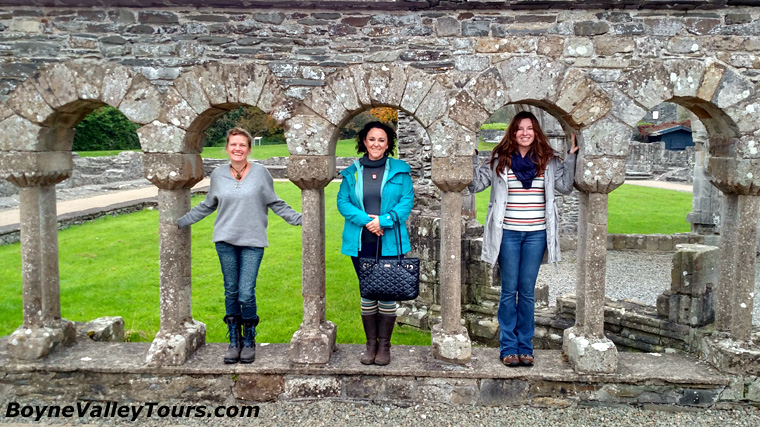
The cloister at Mellifont Abbey in the Boyne Valley.
From the present entrance you look down on the outline of the whole abbey.
Because Mellifont was built by monks sent from Clairvaux by Saint Bernard, its plan follows that of its French mother house.
Nearest the gate, the great abbey church ran east to west, about 58 meters (190 feet) long and 16 meters (54 feet) wide including the side aisles.
Beyond it lay the cloister garth, an open rectangle framed by a covered walk linking the main buildings.
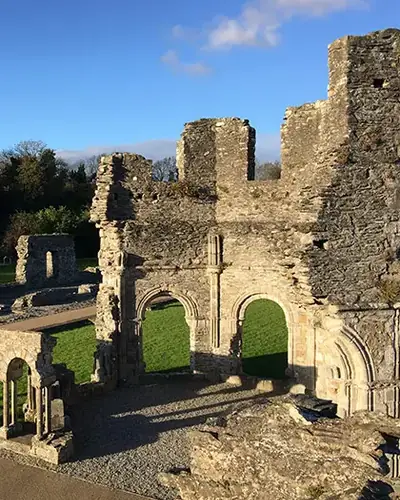
On the east side stands the chapter house, where the community met. Its vaulted ceiling is still intact, though the decorated entrance arch has gone.
Other rooms on this range included offices and stores, with the choir monks' dormitory above.
Opening onto the south cloister were the refectory, kitchen, and warming room.
Four arches of the octagonal lavabo still stand in the cloister garth opposite the refectory entrance. A fountain once stood at the center for washing before meals.
On the west side are the foundations of the lay brothers' quarters.
Excavations show the abbey was expanded and renewed across four centuries of Cistercian life here.
The church's east end was remodeled in the 14th and 15th centuries, and a new chapter house, the one you see today, was built at the same time.
Mellifont Abbey was the first Cistercian monastery in Ireland, founded in 1142 by Saint Malachy.
TripAdvisor Review
After Newgrange and Knowth, Michael took us on an adventure through the countryside to the Battle of the Boyne and Mellifont Abbey. He went above and beyond to give us the best experience possible.
Read the full TripAdvisor review