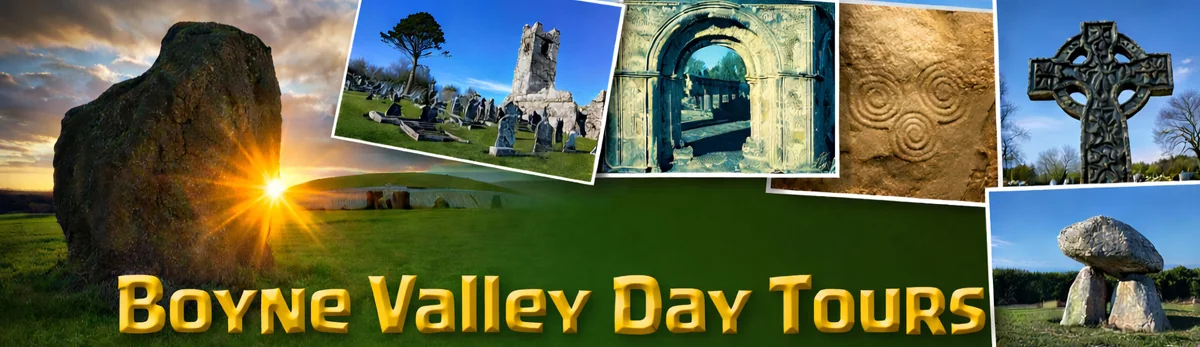
Explore Ireland's rich history and stunning scenery with our specialized private day tours in Ireland's Ancient East.
Discover the historic Boyne Valley, located just north of Dublin, and the picturesque Wicklow region, situated just south of Dublin.
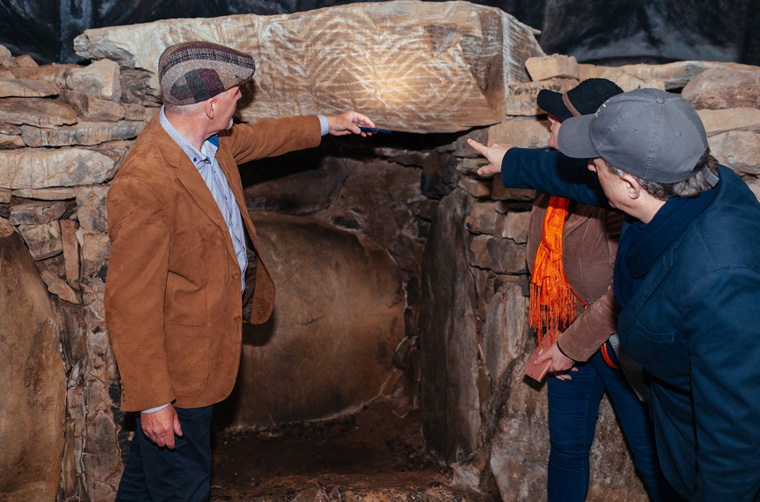
Megalithic Art inside Fourknocks Passage Tomb.
On a Boyne Valley Tour you will experience 5,000 years of Irish culture and history, from the ancient passage tombs at Newgrange,
Knowth, Dowth and Fourknocks, the Hill of Tara where Celtic Kings were crowned, the Hill of Slane where Saint Patrick began his ministry,
the 10th century Round Tower and High Crosses at Monasterboice, Medieval Abbeys at Mellifont and Bective, the gateway town of Drogheda, and Trim Castle the largest Norman castle in Ireland.
On a Wicklow Tour you experience beautiful natural wilderness, landscaped gardens and monastic ruins.
Wicklow is close to Dublin but has scenery to match the west coast of Ireland. The picturesque village
of Avoca is home to the oldest handweavers in Ireland and was the setting for the Ballykissangel TV series.
Our private day tours can be customized so that you can explore the destinations that appeal to you.
Personalized service with collection at Dublin Airport, your hotel or cruise ship in the Dublin / Meath / Louth area.
Pricing
The total tour price is €700 plus booking fees for up to 6 guests, charged per vehicle rather than per person.
Newgrange and Knowth need official OPW timed tickets. When they are on your itinerary, we purchase them on your behalf and add the admission cost to your booking.
Meals are not included. Tours may be extended beyond the standard 8 hours for an additional hourly rate.
Private Shore Excursion to Newgrange and the Boyne Valley direct from Dublin Port Cruise Ship Terminal.
Private transport in a Skoda Superb Sedan for up to three passengers or Mercedes MPV for up to six passengers.
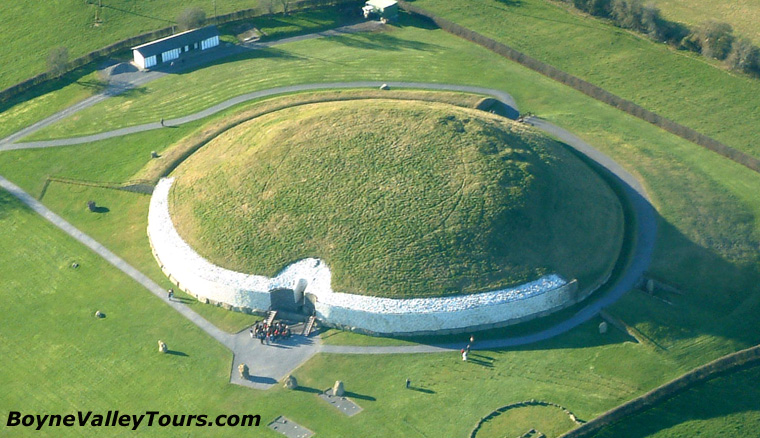
Wonderful aerial views of the river Boyne
Wonderful aerial views of the river Boyne and the passage tombs at
Dowth, Newgrange and Knowth.
Based across the counties of Meath and Louth, the Boyne Valley is an enchanting region brimming with historical significance,
natural beauty, and a captivating heritage. Steeped in myth and legend, this area offers an array of activities for visitors
to immerse themselves in the magic of its surroundings.
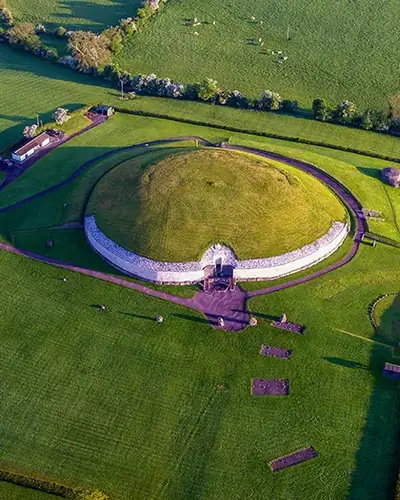
Newgrange is a Stone Age passage tomb built about 3,200 BC, older than Stonehenge and the Egyptian pyramids.
The large circular mound has a long stone passage leading to a chamber. At dawn around the winter solstice, sunlight enters the roof-box and lights the inner chamber.
It stands with Knowth and Dowth at the heart of Brú na Bóinne, Ireland's most famous prehistoric landscape.
Knowth
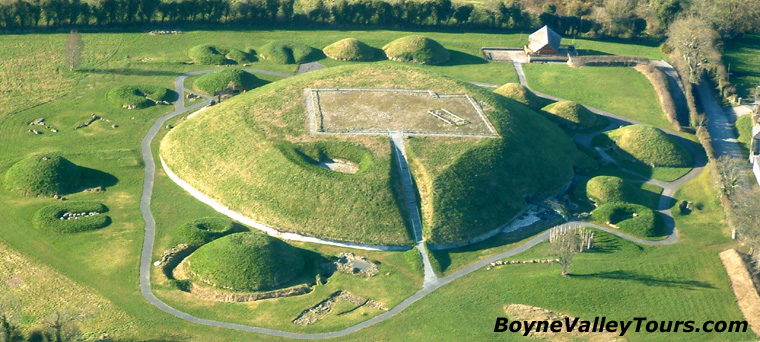
Knowth Great Mound and its satellite tombs.
Knowth is the largest of the three great tombs at Brú na Bóinne. A central mound is ringed by 19 smaller satellite tombs and by a remarkable circle of carved kerbstones.
Two passages run from east and west into the main mound. Knowth holds the greatest collection of megalithic art in Western Europe, and it is usually visited with Newgrange on a guided tour from the visitor center.
Dowth
Dowth Neolithic passage tomb in the Boyne Valley.
Dowth is the quietest of the three great Boyne Valley tombs. It is less restored than Newgrange and Knowth, and it is not part of the ticketed visitor-center tour.
The chambers are closed, but you can walk the mound, look for decorated kerbstones, and take in wide views across the river. Dowth is associated with the winter sunset rather than the sunrise at Newgrange.
Ideal for a first visit to the Boyne Valley, this private tour explores the UNESCO World Heritage landscape of Brú na Bóinne.
Visit Newgrange and Knowth with the official site guides,
then discover places associated with Ireland's ancient kings, mythology, and Saint Patrick.
The day also includes the Hill of Slane and the Hill of Tara.
Price €700 for up to six guests, plus booking fees. Admission fees are extra.
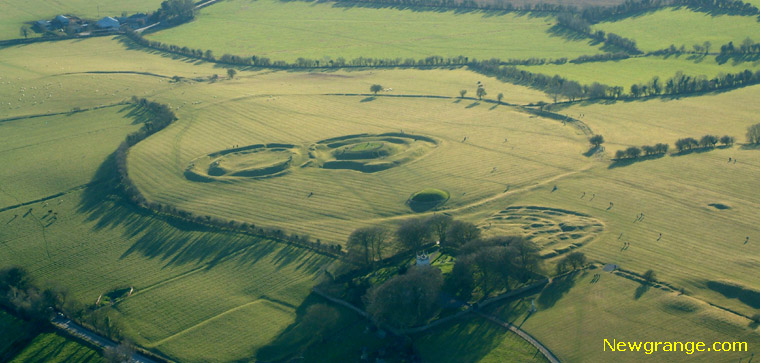
The Hill of Tara, ancient ceremonial center and seat of the High Kings of Ireland.
The Hill of Tara in the Boyne Valley is a ceremonial site associated with kingship rituals.
From the time of the first Gaelic influence until the Anglo-Norman invasion in the 12th Century,
the Hill of Tara was Ireland's political and spiritual capital. The King of Tara represented
a very old ideal of sacred kingship in Ireland, imbued with mythical aura. Many Kings of Tara
were also High Kings of Ireland.
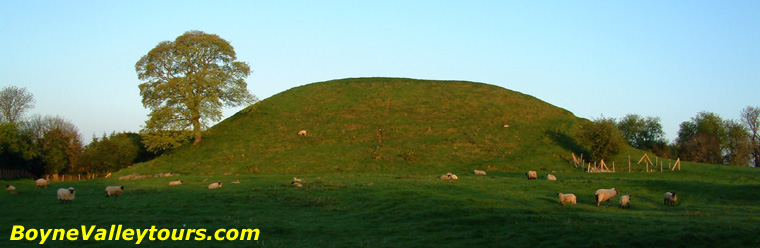
Hill of Slane
The Hill of Slane, with St Patrick's church and friary college.
The Hill of Slane looks over the Boyne Valley toward Newgrange, Knowth and Tara.
Tradition links the hill with Saint Patrick, who is said to have lit a Paschal fire here in challenge to the kings at Tara.
The summit still holds church and friary ruins, a tree-covered mound, and some of the finest views in County Meath.
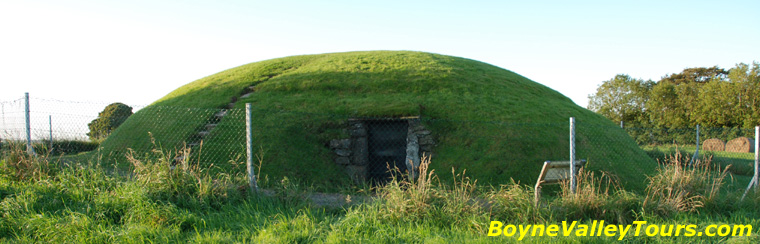
Fourknocks
Fourknocks Megalithic Passage Tomb.
Fourknocks is a passage tomb on a smaller scale to Newgrange; however it is a much more intimate site. There is no
visitor center and seldom anyone else around to disturb the peaceful atmosphere. Spend as long as you want inside the chamber,
studying the wonderful megalithic art or in quiet meditation.
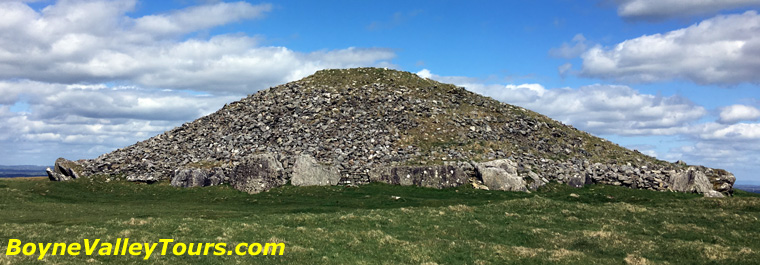
Loughcrew
Loughcrew Cairn T on Carnbane East.
Loughcrew is a complex of 5,000 year old cairns on the hills of County Meath, west of the Boyne Valley.
Stone Age symbols are carved on the backstone of Cairn T, which is illuminated by the rising sun at the spring and autumn equinoxes.
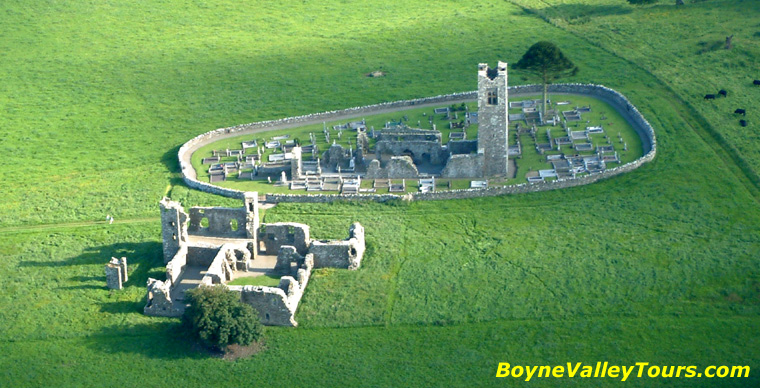
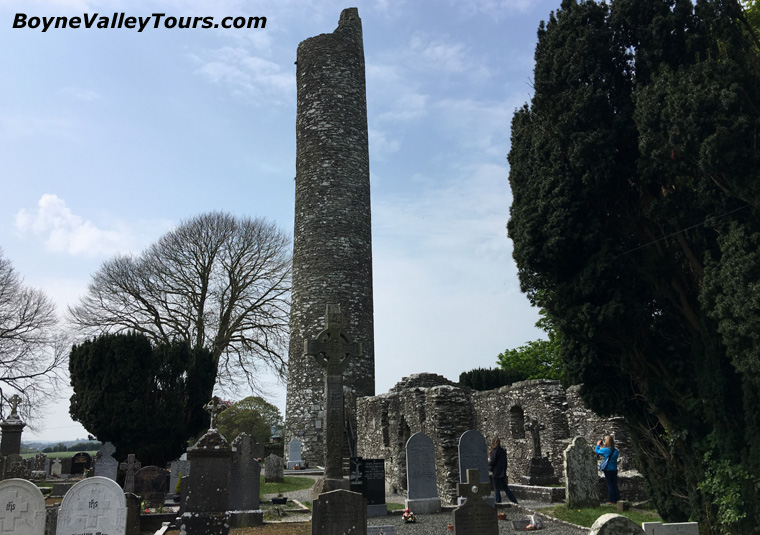
Monasterboice
Monasterboice round tower, high crosses and ruined churches.
Monasterboice is one of Ireland's most important early Christian sites, founded in the 6th century.
It is best known for its round tower and two 10th century high crosses, including Muiredach's Cross, with detailed biblical carvings.
The monastery remained a major center of learning until nearby Mellifont Abbey was founded in 1142.
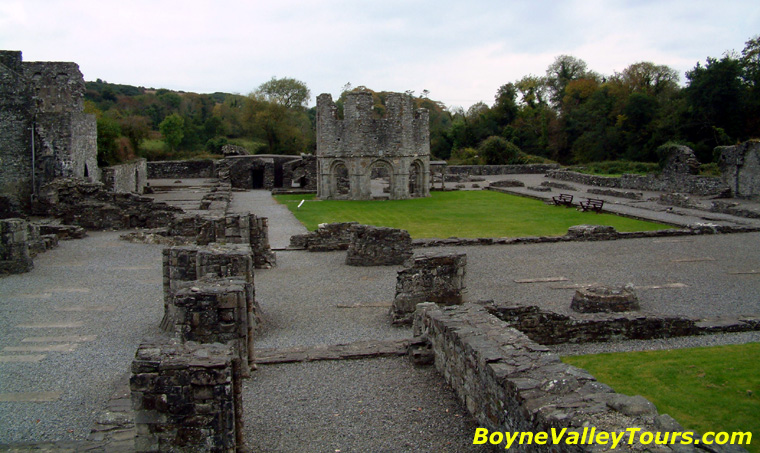
Mellifont Abbey
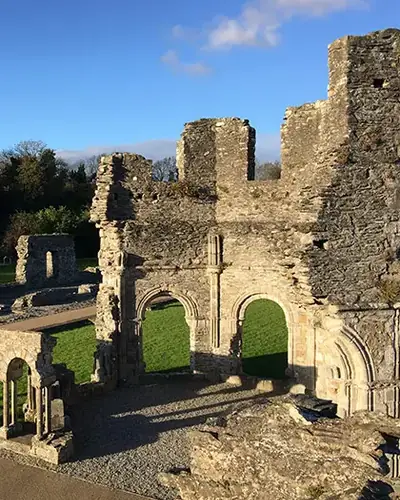
Old Mellifont Abbey, Ireland's first Cistercian monastery.
Mellifont Abbey was Ireland's first Cistercian monastery, founded in 1142 by Saint Malachy, Archbishop of Armagh.
Little of the original abbey survives, but the 13th century lavabo still stands, an octagonal stone pavilion where the monks washed before meals.
The ruins lie a short drive from Monasterboice and Drogheda, and they pair well with both on a Boyne Valley day.
Designed for visitors who enjoy medieval history, atmospheric ruins, and photography, this private Boyne Valley tour explores castles, abbeys, and early Christian monuments.
Stops include Ireland's largest Anglo-Norman fortress at Trim Castle,
the monastic ruins of Mellifont Abbey and Bective Abbey,
and the high crosses at Monasterboice.
The day can also include the Hill of Slane and Slane Castle when available.
Price €700 for up to six guests, plus booking fees. Admission fees are extra.