Trim Castle is the largest Anglo-Norman castle in Ireland and one of the great stops on a Boyne Valley day.
Hugh de Lacy began building here after King Henry II granted him the Liberty of Meath in 1172.
The massive three-story keep was started in 1176 on the site of an earlier wooden fortress.
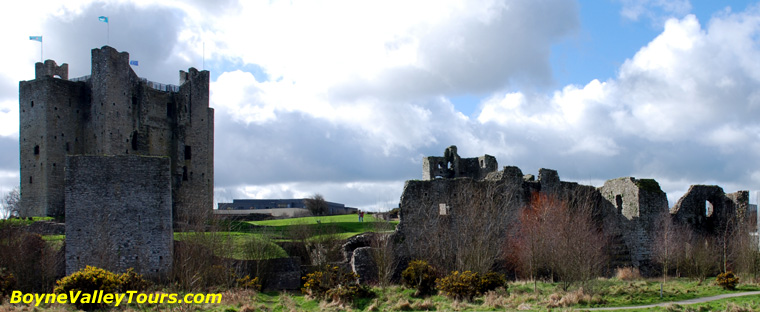
Its twenty-sided, cruciform tower still dominates the River Boyne, once protected by a ditch, curtain wall, and moat.
The keep at Trim Castle in the Boyne Valley.
Today you can walk the castle grounds for free, then take a timed guided tour into the keep with the Office of Public Works Guide.
The climb rewards you with close views of thick stone walls, spiral stairs, and wide vistas over Trim and the Boyne.
Film fans may also recognize the castle as King John's Castle in Mel Gibson's 1995 film Braveheart.
On a private tour, Trim pairs naturally with nearby abbeys and early Christian sites, so you can see how Norman power, monastic life, and river trade shaped the Boyne Valley together.
Allow time for photos from the yellow gorse banks below the walls, and for a stroll through Trim's heritage town after your visit.
Designed for visitors who enjoy medieval history, atmospheric ruins, and photography, this private Boyne Valley tour explores castles, abbeys, and early Christian monuments.
Stops include Ireland's largest Anglo-Norman fortress at Trim Castle,
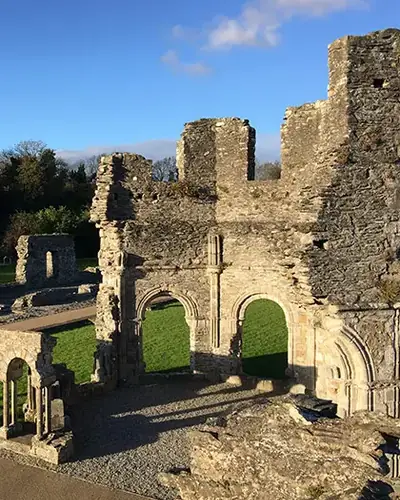
the monastic ruins of Mellifont Abbey and Bective Abbey,
and the high crosses at Monasterboice.
The day can also include the Hill of Slane and Slane Castle when available.
Price €700 for up to six guests, plus booking fees. Admission fees are extra.
The story of Trim Castle runs from a river ford and an early monastery to the stone fortress that still commands the Boyne.
The ford of the elder trees
Trim grew up at a crossing of the River Boyne.
The Irish name, Baile Átha Troim, means the place of the ford of the elder trees.
Before the Normans, an early monastery is said to have been founded here by St Patrick.
Nothing of that first church survives above ground, but archaeological work points to the area around St Patrick's Cathedral.
A settled community, rich farmland, and a river crossing made Trim a natural capital for Hugh de Lacy's lordship of Meath.
Hugh de Lacy and the Lordship of Meath
Hugh de Lacy (c.1135 to 1186) came from a landed family in Herefordshire and Shropshire.
In October 1171 he crossed to Ireland with King Henry II as part of the main Anglo-Norman army.
The king granted him the Lordship of Meath, a vast holding that covered modern Meath and Westmeath and parts of Kildare, Offaly, and Wicklow.
He still had to take and hold the land. Across his estates he raised motte-and-bailey defenses, with Trim as the center of power.
The chronicler Giraldus Cambrensis left a famously unflattering portrait of him, dark-eyed, short-necked, and marked by a burn down one side of his face.
From timber ringwork to stone fortress
The castle you see today is not de Lacy's first work on the site.
He began with a timber ringwork behind earth banks.
In 1174 the Irish High King Ruaidrí Ua Conchobair captured and burned it during a campaign to drive the Normans out.
De Lacy rebuilt in stone: a deep moat, strong curtain walls, and a keep of unusual plan.
From above the donjon reads as a cross, with towers projecting north, east, south, and west.
That gives the building twenty sides to defend. All of those towers survive except the northern one.
Rows of square putlog holes still mark the walls. They once held timber hoardings, so defenders could shoot or drop stone from a covered walk high on the keep.
Walter de Lacy and the de Genevilles
Hugh de Lacy was killed at Durrow in 1186. His son Walter inherited Trim and raised the keep by another story.
Later, Walter's granddaughter Maud and her husband Geoffrey de Geneville added a great hall in the bailey.
Its rectangular footprint is still easy to pick out from the roof of the keep.
The castle was only part of a wider defended town. Little of the town wall remains, but the Sheep Gate still stands on the far bank of the Boyne, near the Yellow Steeple of the former Augustinian house of St Mary's.
Ruin, film set, and a medieval keep
By the later 1600s the fortress had slipped into decay.
It never became a grand country house in the Georgian or Victorian centuries, as Kilkenny Castle did, so the medieval fabric was left largely unaltered.
A new public life began in 1995, when Mel Gibson filmed Braveheart here.
Inside the keep, modern walkways give access without pretending to restore lost floors.
You can read the building phases in the stone and take an Office of Public Works guided tour.
A walk along the opposite bank of the Boyne is worth adding, with views back to the walls and more of Trim's medieval skyline.
Trim Castle is the largest Anglo-Norman castle in Ireland.
Meath's Medieval Monolith
Trim Castle is one of the finest examples of Norman architecture still standing
in Ireland today.
Their legacy has long outlived their days of power and reminders of
this fascinating legacy continue to dominate the Irish landscape.
The Normans had interesting ideas about government and
administration, and they were certainly good organizers. But
nowadays it is easier to consider them not as soldiers but as
innovative architects, as builders of genius. Norman castle design,
inspired by the demands of defense, ironically resulted in
structures of great beauty. There is nothing particularly appealing
about a modern derelict building, but Ireland's ruined stone
castles and tower houses are objects of beauty as well as signposts
to Ireland's history.
The greatest of these Norman creations is King John's Castle at
Trim, Co Meath, the largest Anglo-Norman castle in Ireland. Viewed
against the night sky it conjures up the usual images of romance
associated with castles. By day, however, it looks every inch the
formidable military bastion it was intended to be.
Its massive three-story stone keep, or main building, is the
definitive stronghold. It possesses a bewildering 20 sides and
three of its original four towers still flank it. Approached from
the road, past the Barbican Gate, the castle stands tall behind the
curtain wall built to protect it from potential invaders. So
effective was this, and the castle's other defenses, that it took a
one-time owner, Walter de Lacy (son of Hugh), returning from a
visit to England in 1223, some seven weeks to regain his property.
Long before the arrival of Hugh de Lacy, Trim, the Town of the Ford
of the Elder Tree, had an earlier monastic history. If most castles
are built with strategic notions in mind, few in Ireland are quite
as brilliantly located as Trim. It overlooks a crossing on the
Boyne and even now, some 800 years after it was built, the castle
still dominates the town that has respectfully developed around it.
At a time when so many ill-advised planning decisions are now
lamented, having left numerous ancient monuments and surviving
monastic and settlement sites surrounded by incongruous modern
industrial and residential estates, Trim Castle has somehow
retained a vivid sense of the landscape that would have originally
surrounded it. The town has kept its distance; the view from the
castle across the river to the north banks of the Boyne is of
extensive open commonage.
All of which adds to the drama of the Trim fortress. Imagination as well as common
sense are useful when it comes to exploring this vast stone castle,
which had declined long before Oliver Cromwell arrived in the area.
Already semi-ruined by then, the castle was besieged by Royalist
forces and was used for a while as a Cromwellian base.
Some years later Richard Pococke (1704-65), Archdeacon of Dublin,
later Bishop of Meath and a remarkable traveler who had explored
Egypt and the Alps before tackling Ireland, conscious of Trim's
history, wrote in 1753 as he toured Co Meath: "But the greatest
piece of Antiquity is a very large Castle called King John's
Castle, which is a building of great Strength, the enclosure
extending to the river."
By the 18th century Trim Castle had been finally, and definitively,
abandoned. Its relatively short career as a habitation has left us
with the advantage of being able to look at an Anglo-Norman castle
that, although constructed in three main phases over a 50-year
period, was never subject to later renovations, rebuilding or
remodeling. There is no clash of contrasting architectural styles,
there are no Victorian bits and pieces, it was conceived as a
Norman castle, and so it remains. Its neglect does not appear
important, such is the extent of its preservation.
If we consider castles in general, however glorious such structures
appear, and Trim is particularly impressive, they were not easy
places to live in. Cold, drafty, denied of light as large windows
could be exploited by intending invaders, life in a castle was
difficult. Added to this were the smells and the obvious lack of
privacy. Still, as we were neither under siege nor contemplating
invasion the other day as we assembled with a group to tour the
keep, adventure and curiosity guided us.
Adventure, curiosity and Nichola McDonagh of the OPW, who held what
looked like a giant's key to the keep's only entrance, a huge
wooden door. She is the site's chief custodian. Surveying the
adults and children before her in the strong, cold wind of a
typical March Sunday afternoon, she glanced up at the castle and
across the 1.2 hectare (3 acre) site before asking rhetorically: "Who were
the Anglo-Normans?" She then proceeded to outline their origins.
"They were descendants of the Norsemen who had settled in Normandy,
in France." Obviously they were not typical tourists, their plans
being expansionist in character. Having set their sights on
England, the Battle of Hastings in 1066 marked the beginning of the
reality.
Standing in the shadow of a ruined castle in Co Meath might seem
eons removed from Norman ambitions. Yet it was to prove central.
In an attempt to contain the developing relationship between a
Norman baron, Richard de Clare, Earl of Pembroke, better known to
history as Strongbow, who had established an alliance with the
native Irish by marrying the daughter of Diarmaid Mac Murrough,
Henry II sent Hugh de Lacy to Ireland. Henry had earlier relieved
Strongbow of his earldom and there was immense ill-will between
them. De Lacy was already a wealthy man, but the king, in order to
sustain his interest and loyalty, granted de Lacy in 1172 the
ancient Irish kingdom of Midhe, which included not only all of the
modern county of Meath but a vast territory extending west to the
Shannon.
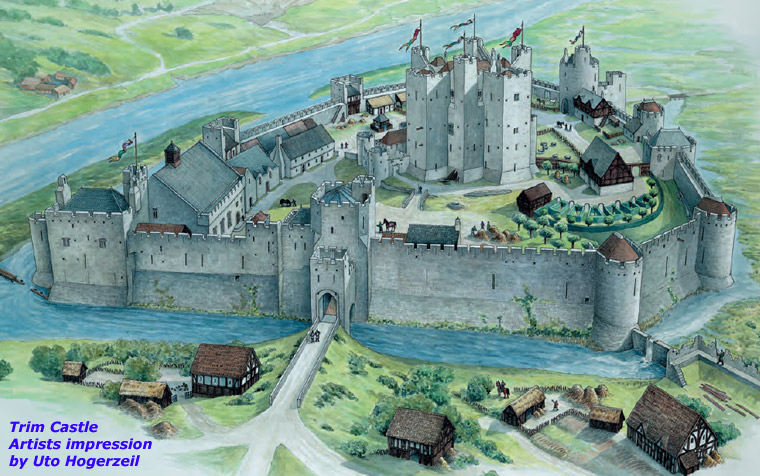
Trim Castle - Artists impression by Uto Hogerzeil.
To any discerning empire-builder, and de Lacy is certainly the
architect of Norman Meath, the site where Trim Castle now stands
must have appeared ideal for the construction of any stronghold. De
Lacy's initial building project was not a stone castle, it was a
timber fort, encircled by that first line of defense, an earthen
trench or ditch which was further consolidated by a stockade. Work
on what would become the great stone castle we see today began about 1176.
For a few moments history seems to overshadow the castle itself,
but McDonagh knows how to tell her story and tells it well. The
world of Shakespeare's history plays comes to life as, after all,
this is the world that instigated the construction of Trim Castle.
She describes the castle as a residence but, more importantly, as a
place of administration, the equivalent of "a modern office block".
Pointing out the three surviving towers, she tells us we are
standing in the space formerly occupied by the collapsed fourth,
which appears to have simply fallen away from the core block of the
keep, leaving a seam-like scar. It also provides a useful cross-
section of the castle plan. A platform-like modern stairway leads
to the keep's door, which is high above ground level for obvious
reasons of defense.
On entering the castle, visitors stand in what was known as the
"disarming area" this was where you handed over any swords or
weapons you were carrying. Fresh water is crucial to all life,
particularly as lived in a medieval castle.
"There was no well or spring here, and this is a major flaw at
Trim," McDonagh says, and adds that the surest way to pollute the
water supply of any castle under siege was to "throw in a dead
animal and let nature take its course". But the Normans were
clever, McDonagh explains, outlining the methods they used to
collect rain water for storage in vast water tanks.
Inside a large room that once served as the original great hall
there were two subsequent great halls, one on the top floor or
third story, and then later outside by the curtain wall are
three models that explain the three main building phases. The first
was undertaken by Hugh. But his life was cut short by an assassin
at the monastic site of Durrow, Co Offaly. There, at the place
where Colmcille or Columba had established a church, de Lacy's head
was severed from his shoulders by a native Irishman who naturally
was not charged with the crime.
With Hugh dead, his son Walter, after a wait of three years while
he came of age, took over and the castle was further enlarged and
improved. Plinths were added to the base to make the job of
invading sappers or miners that bit more difficult. Some 30 years
after the original castle construction began came phase three and
the addition of the third story.
Back in the east tower we visit the chapel, accessed by a spiral
stairway. A carved stone trough or piscine used for washing the
altar vessels still remains. Traces of what would have been a
three-light glazed window may be seen. In the Middle Ages, glass
was a definite status symbol. The only problem was that it was
difficult to see through. That the various castles' roofs were once
tiled is evident from the four and a half tons of broken tiles
excavated at the site as were 17 human heads.
Every modern-day castle visitor is shown the garderobe or privy,
over which, as McDonagh explains, clothes were hung. Nothing was
ever washed, but the fumes from the human waste killed lice and fleas.
There are three rooms on each floor in each of the towers and in
the keep. Once out on the roof, you become aware of how high the
castle stands.
The view includes the Wellington monument, the steeple of St
Peter's and glimpses of the modern town of Trim. The hero of
Waterloo is believed to have been born in Trim and educated
locally, at least for a time, at St Mary's Abbey, on the north bank
across the river from the castle. Views of the Dublin and Wicklow
mountains are seen with varying levels of clarity depending on
conditions.
Far closer, only about 1.6 km (1 mile) away, is the extensive ecclesiastical
site of Newtown. The Boyne rushes by. But 800 years on, Trim Castle
stands firm.
Michael arranged a marvelous full day tour of Boyne Valley for us.
Besides the Neolithic sites of Newgrange, Knowth and Dowth, which were a must for us, he included Mellifont Abbey, several High Irish Crosses and a fascinating image called Sheela-na-gig.
Michael is a professional guide with incredible knowledge of the Boyne Valley.
Read the full review
Fáilte is Irish for Welcome and is something that Michael exudes.
From the friendly handshake to start the day until he waved goodbye at the end you feel welcome to be in Ireland and on the tour.
All through the day Michael was a source of interesting conversation on an amazing variety of topics and he made the tour fun and informative.
- Todd M, Richmond, Canada.
Read the full review
Michael was superb in exceeding our aspirations, our detailed questions and great company to spend the day with.
I was delighted with the high quality of Michael's tour, real attention to detail,
and a personal service delivered with genuine insight and humor.
- Marion and Mike.
Read the full TripAdvisor review from Marion and Mike