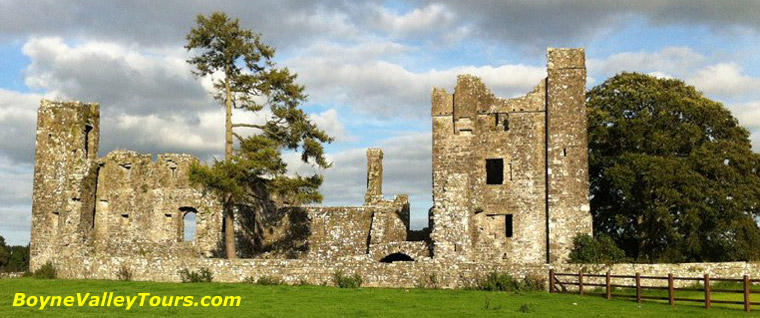
Bective Abbey stands on a high bank of the River Boyne, roughly halfway between Navan and Trim. Founded in 1147 by Murchad O'Melaghlin, King of Meath, it was Ireland's second Cistercian monastery and a daughter house of Mellifont Abbey in County Louth. Dedicated to the Blessed Virgin Mary, and once known as the Abbey of Beatitude, it was the only Cistercian foundation in Meath. The order sought a simpler monastic life, and that ideal shaped the restrained character of Cistercian building.
Bective Abbey, founded in 1147.
At its height Bective was a major settlement. Its mitred abbot sat as a spiritual lord in the Parliament of the Pale. Estate lands included granges, a watermill, and a fishing weir on the Boyne. Later surveys put the demesne at well over a thousand acres. In 1195 the body of Hugh de Lacy, the Anglo-Norman lord of Meath who built Trim Castle, was brought here for burial after his death at Durrow, while his head went to St Thomas's Abbey in Dublin. The two houses disputed the remains until the Bishop of Meath settled the matter in 1205 in favor of St Thomas's, and de Lacy was reunited in Dublin.
Designed for visitors who enjoy medieval history, atmospheric ruins, and photography, this private Boyne Valley tour explores castles, abbeys, and early Christian monuments.
Stops include Ireland's largest Anglo-Norman fortress at Trim Castle,
the monastic ruins of Mellifont Abbey and Bective Abbey,
and the high crosses at Monasterboice.
The day can also include the Hill of Slane and Slane Castle when available.
Price €700 for up to six guests, plus booking fees. Admission fees are extra.
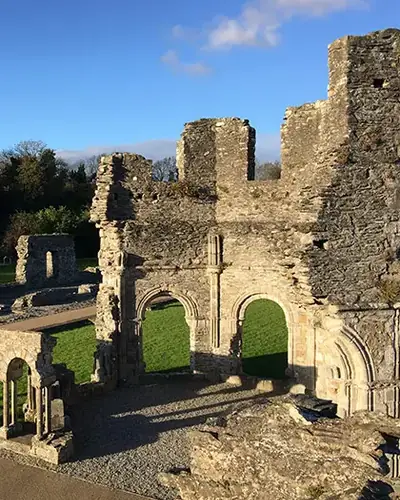
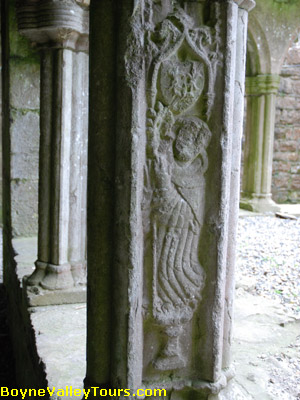
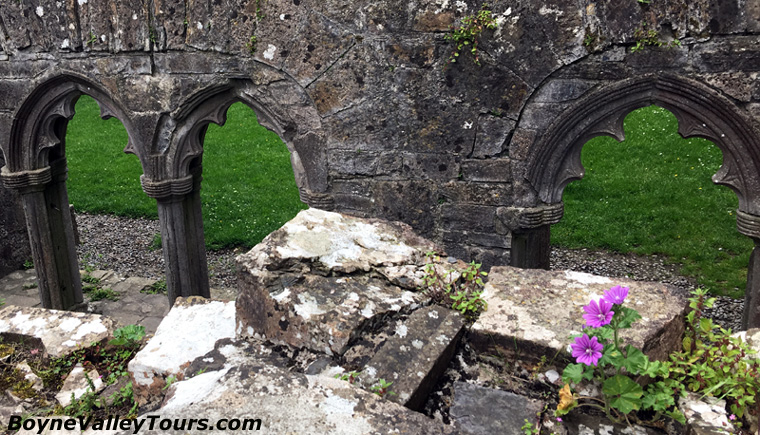
Much of what you see today dates from the 13th to the 15th centuries: church fragments, chapter house, cloister, and domestic ranges. The cloister is especially fine, with pointed Gothic arches, clustered pillars, and carved capitals in hard Ardbraccan stone. Delicate foliage and bird motifs survive on some columns, and one pillar bears a carving traditionally identified with St Bernard of Clairvaux, a key figure in the Cistercian reform. The community became strongly Anglo-Norman. In 1386 men of Irish birth were effectively barred from entering the monastery. In the 15th century the cloister and living quarters were rebuilt on a smaller scale. Two stretches of that cloister walk still stand.
A large defensive tower rose above the south range in the same century, a sign of unsettled times on the edge of the Pale. After the Dissolution of the Monasteries under Henry VIII in 1536, Bective was suppressed and its lands taken. The complex was later turned into a fortified mansion, with new fireplaces, chimneys, and large mullioned windows. The property passed through several families before coming to the Boltons, who held it for centuries and in the early 1800s built nearby Bective House. Archaeological work in 2009 to 2012 uncovered a large medieval barn, adding to the picture of monastic farming and daily life beside the Boyne.
Bective Abbey Cloister.
The castle-like ruins have drawn filmmakers more than once. With nearby Trim Castle, Bective featured in Mel Gibson's 1995 film Braveheart, including a cloister scene with the princess and her maid. Earlier, in 1955, it appeared in Captain Lightfoot with Rock Hudson. More recently, Ridley Scott used the site for The Last Duel (2020), with Matt Damon, Adam Driver, Jodie Comer, and Ben Affleck.
Bective Abbey, Boyne Valley, Ireland.
On a private Boyne Valley day tour, your driver-guide can combine Bective with Trim Castle, Mellifont, and other stops along the river. The abbey is free to enter and makes a rewarding pause among fields and stone, with time to walk the cloister, climb interrupted staircases, and hear how a Cistercian house became a mansion and a film set.