Drogheda on the Boyne
Drogheda is the medieval gateway town to the Boyne Valley and a natural base for exploring Ireland's Ancient East. It sits on the River Boyne in Co. Louth, Ireland's smallest county, about 20 minutes from Dublin Airport. The Irish name Droichead Átha means Bridge of the Ford. Quiet lanes open onto busy streets of shops, cafés, and restaurants, and most of the town's best sights lie within an easy walk of each other.
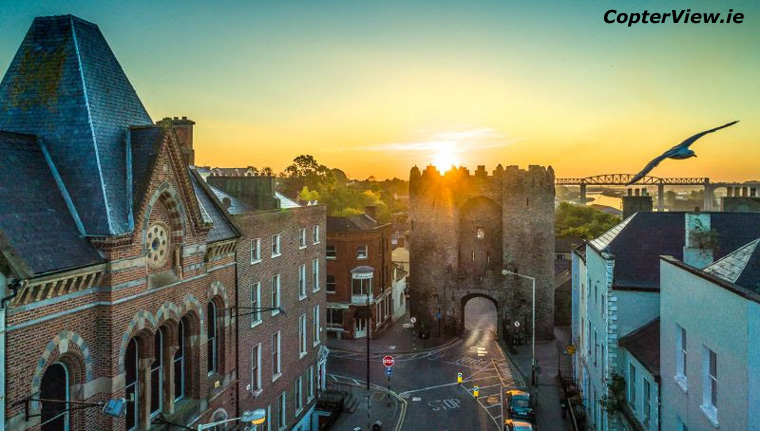 St Laurence's Gate, Drogheda | Medieval barbican.
St Laurence's Gate and the Town Walls
Hugh de Lacy granted Drogheda its charter in 1194. The Anglo-Normans made it one of their main strongholds, and the town walls were completed in 1334. The medieval walled area enclosed about 46 hectares (113 acres), making Drogheda one of the largest walled towns in Ireland at the time. Only fragments of the walls survive, but St Laurence's Gate remains the landmark visitors come to see.
The gate consists of two lofty circular towers joined by a wall with an archway. It is widely regarded as one of the finest barbicans of its kind in Europe. Originally the east gate, it was renamed in the 14th century because the street led to the Hospital of St Laurence. You can view it free of charge at the end of Laurence Street. There is no public entry into the gate itself. South of the gate, Featherbed Lane shows the impressive height of the old medieval walls. Allow about half an hour if you are photographing the gate and walking the nearby streets.
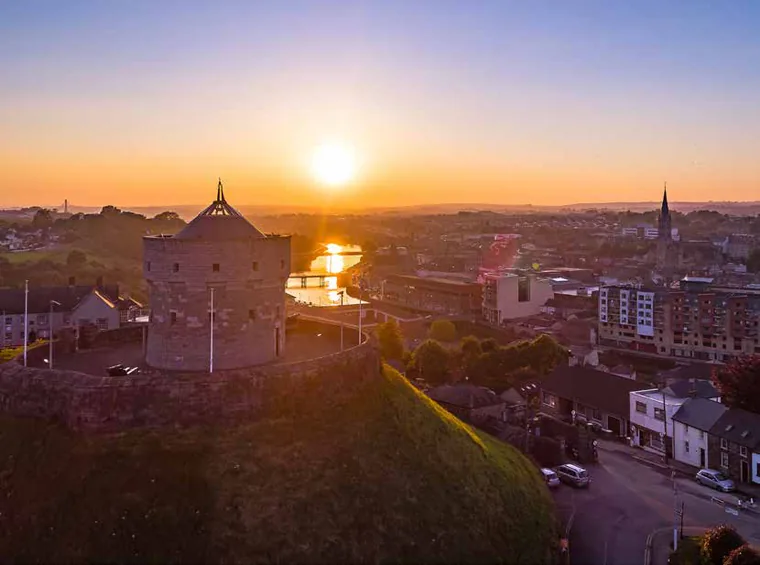 Millmount Tower overlooking Drogheda and the Boyne.
Millmount Museum and Martello Tower
High above the south bank, Millmount is the place to start if you want the story of the town in one stop. The Napoleonic-era Martello Tower, often nicknamed the Cup and Saucer, stands on a Norman motte, and local tradition links the mound with an earlier burial place associated with the poet Amergin. From the hilltop you get wide views over the Boyne, the town spires, and the great Victorian Boyne Viaduct.
Drogheda Museum at Millmount covers military history, industrial life, and local craft collections. The mound is also tied to the darkest chapter in the town's story: Oliver Cromwell's capture of Drogheda in 1649, when the walls were breached and many of the Royalist defenders were killed. The tower was later damaged in the Irish Civil War in 1922 and restored in 2000. Craft shops beside the museum are worth a browse after you leave the exhibitions.
St Peter's Church and St Oliver Plunkett
On West Street, the Gothic Revival St Peter's Roman Catholic Church holds the shrine of St Oliver Plunkett, Archbishop of Armagh, who was executed in London in 1681. His preserved head is one of the most visited religious relics in Ireland, and many visitors pause here as part of a town walk. St Augustine's Church nearby is another stop for stained-glass enthusiasts, with a Harry Clarke Studio window.
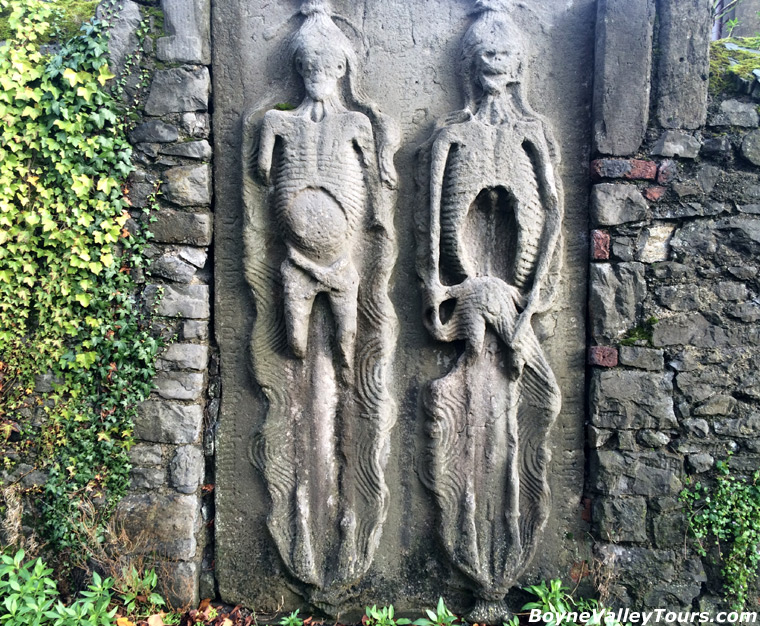 Cadaver stone from the tomb of Sir Edmond Goldyng and his wife Elizabeth Fleming.
At the east end of town, near St Laurence's Gate, the Church of Ireland St Peter's occupies what is probably Drogheda's earliest religious site. In the graveyard is the 16th-century cadaver stone from the tomb of Sir Edmond Goldyng and his wife Elizabeth Fleming. These macabre memorials, showing the body in a skeletal or decaying state, were made in the 16th and 17th centuries to remind people of mortality and the briefness of life.
Arts, the Tholsel, and a Walkable Town Center
Highlanes Gallery, in a former Franciscan church, shows contemporary and historical art in a calm town-center setting. Droichead Arts Centre and other local venues keep music, drama, and festival events in the mix through the year. For maps and orientation, call into the Drogheda Tourist Information Office in the historic Tholsel on West Street, where an interactive exhibition introduces Drogheda and the wider Boyne Valley under themes such as ancient sites, conflict, and sacred places.
If you prefer to explore on foot, follow a heritage trail past Magdalene Tower, the Old Abbey remains, and the riverfront, or use Dominic's Park on the Ramparts for a green break beside the Boyne. The River Boyne still shapes the town: it once divided two settlements on opposite banks, now joined by bridges including the de Lacy Bridge, named for the Norman lord who founded the port.
Day Trips from Drogheda
Drogheda is an ideal base for the valley's headline sites. A short drive west brings you to Monasterboice with its high crosses and round tower, Mellifont Abbey, and the Battle of the Boyne Visitor Center at Oldbridge House, where William III defeated James II in 1690. Further inland are Newgrange, Knowth, and Dowth at Brú na Bóinne. Closer options include Beaulieu House and gardens by appointment for groups, and tasting visits at Boann Distillery on the edge of town.
On a private day tour we often combine a short Drogheda stop, Laurence's Gate, Millmount views, or St Oliver Plunkett's shrine, with timed visits to Brú na Bóinne or a loop that includes Monasterboice and Oldbridge. Tell us what you most want to see and we will shape the day around your pace and interests.
Nao Santa María visits Drogheda
In July 2026 a full-scale replica of Christopher Columbus's flagship, the Nao Santa María, tied up at Drogheda Port on the Boyne. Built in Spain by the Fundación Nao Victoria, the wooden nao is a floating museum: visitors can walk the decks, go below, and see how a late fifteenth-century ocean ship was steered with a whipstaff rather than a wheel.
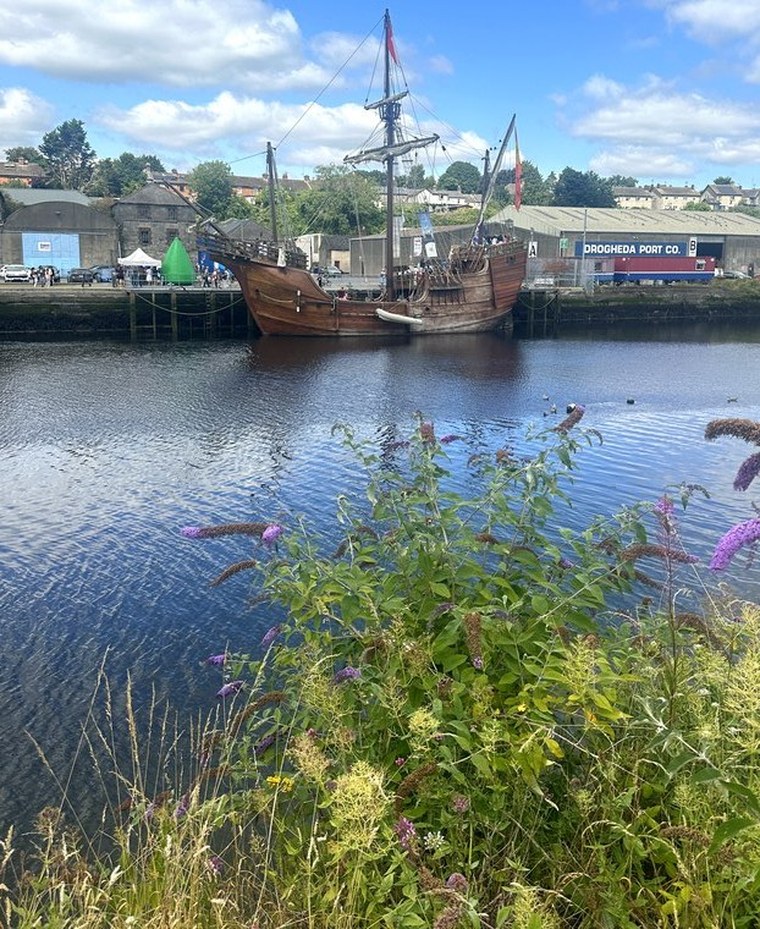 Nao Santa María at Drogheda Port | Visit the ship page.
TripAdvisor Review
The Irish history lesson, Celtic crosses, historical monuments, Newgrange and Knowth left us with a wonderful first day in Ireland. Michael made us feel like family. Read the full TripAdvisor review