Dowth, known in Irish tradition as Dubad or Dubhadh, is one of the three great Neolithic passage tombs of
Brú na Bóinne, the Bend of the Boyne World Heritage landscape in County Meath.
Together with Newgrange and Knowth, it forms the heart of Ireland's most famous prehistoric cemetery,
built around 5,000 years ago. Less reconstructed than its famous neighbors, Dowth keeps a brooding, overgrown presence.
The Irish name is linked with darkness or darkening, a fitting association for a mound whose best known astronomical moment
is the winter sunset rather than the sunrise celebrated at Newgrange.
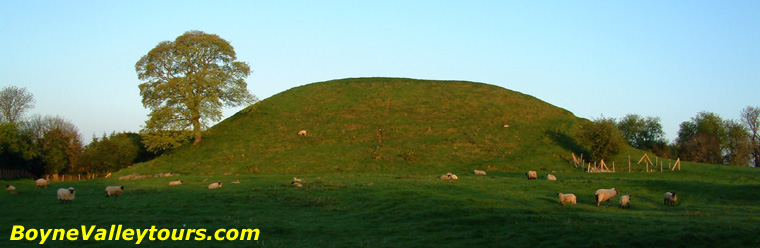
Dowth Neolithic passage tomb in the Boyne Valley.
Unlike Newgrange and Knowth, Dowth is not part of the ticketed tour from the Brú na Bóinne Visitor Center.
It stands on elevated ground on the north bank of the Boyne, a short distance from the Slane to Drogheda road,
and can be reached as a quieter stop on a private Boyne Valley day tour.
There is no public access to the two passage chambers, which are closed for safety.
Visitors can walk the mound, look for decorated kerbstones, and enjoy wide views across the valley without the busier pace of the official Newgrange and Knowth visits.
Spend a day immersed in Ireland's prehistoric landscape, with more time to appreciate ancient passage tombs, megalithic art, and quieter archaeological sites.
Following official visits to Newgrange and Knowth, the day continues to monuments such as
Dowth and Fourknocks.
Price €700 for up to six guests, plus booking fees. Admission fees are extra.
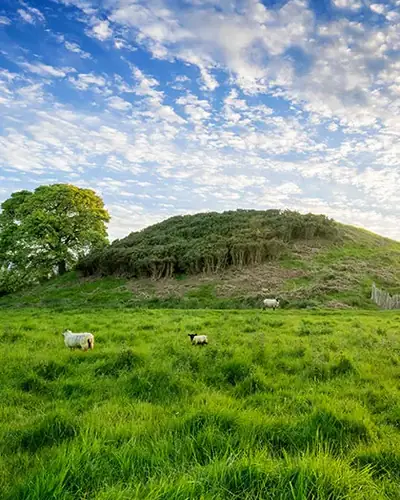
The main Dowth mound is about 85 meters (280 feet) across and about 15 meters (50 feet) high.
A large crater scars the summit, a lasting reminder of nineteenth century digging.
Around the base runs a kerb of large stones, estimated at about 115 in total.
Many are partly or completely buried, so only a portion of the circuit is easy to see today.
Roughly fifteen kerbstones carry carved designs, while wider surveys of the site record megalithic art on a larger number of stones inside and out.
Circles, rayed discs, spirals, arcs, and cup marks are among the motifs.
Quartz found outside the kerb suggests that the entrances once had a bright white setting, similar in idea to the famous quartz face at Newgrange.
That façade does not survive as a reconstructed wall at Dowth. The mound remains grass covered and unrestored.
Thorn, gorse, and shadow still cling to it. That unfinished quality is part of its power:
Dowth does not present the ancient world tidily, and it asks visitors to approach through uncertainty.
Dowth North and Dowth South
Two passage tombs open on the western side of the mound, often called Dowth North and Dowth South, and they are a short distance apart.
They are smaller and less dramatic than the chambers at Newgrange and Knowth, yet they preserve important structural and artistic detail.
Dowth North has a cruciform chamber with three recesses and an unusual annex off the right hand recess.
A large stone basin sits on the chamber floor, and the roof rises to about 3 meters (10 feet).
The present length of the northern passage is shorter than older published figures,
reflecting disturbance at the entrance and later works that cut into the original approach.
An early medieval souterrain was later linked into this tomb, a reminder that Dowth remained part of a living landscape long after the Neolithic.
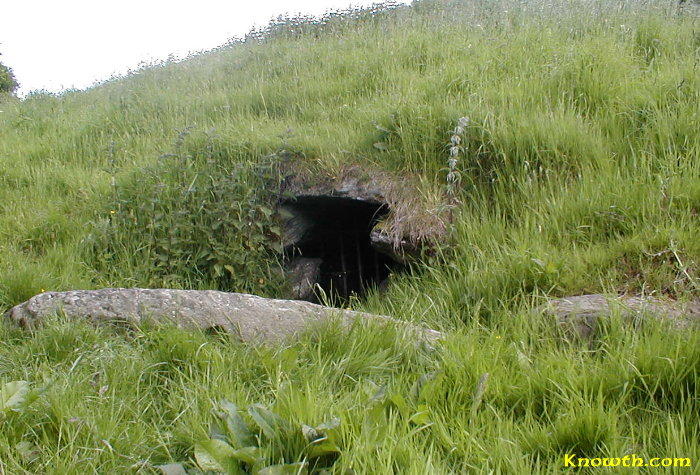
Dowth South has a short passage of about 3.5 meters (11.5 feet) leading to a simple circular chamber with a single recess to the right.
The original roof collapsed long ago and has been replaced with concrete.
The entrance is marked by a decorated kerbstone with cup marks and other designs.
Despite its modest scale, Dowth South is the chamber most closely tied to the site's winter light spectacle.
Entrance to Dowth South passage and chamber.
Winter Solstice Sunset
Where Newgrange is famous for catching the rising sun at midwinter, Dowth South faces west and is aligned to the setting sun around the
winter solstice.
On clear evenings near 21 December, low sunlight can enter the short passage, cross the sill, and illuminate the chamber and rear stones.
The light may be visible across a wider winter window when the sun is low enough, though the strongest effect is around the solstice itself.
Together the two monuments create a powerful counterpoint: dawn and dusk, the returning sun and the sun's descent, brightness and Dubad.
Modern interest in Dowth's solar behavior was revived in the late twentieth century through careful observation and photography,
including detailed winter studies from the 1990s onward.
Dowth South is generally opened only for the winter solstice sunset on December 21. Chamber access is not normally available at other times
and remains subject to OPW arrangements. For most visitors, Dowth is experienced from outside, with the great mound and surrounding Boyne Valley
landscape providing an atmospheric setting.
Damage, Discovery, and Later History
Dowth has been known to antiquarians since at least the eighteenth century, when a folly was built on the summit.
The most damaging episode came in 1847 and 1848, when a poorly conducted excavation for the Royal Irish Academy
dug into the center of the mound in search of a Newgrange style chamber.
The work left a deep crater, produced little lasting record, and seriously harmed the monument.
That wound remains visible and is part of the mound's later biography: a reminder that curiosity can illuminate the past,
but can also injure what it seeks to understand.
Later stone removal for building and roads made the damage worse.
The site came into State care in 1882. Further opening works in the later nineteenth and early twentieth centuries
also altered the northern entrance.
Unlike Newgrange and Knowth, Dowth was never fully excavated or reconstructed in the modern era.
Survey and study in the later twentieth century, followed by laser scanning and digital modeling,
have helped document the passages and chambers without turning the mound into a restored showpiece.
Medieval annals also place Dowth among Boyne Valley sites associated with later raids on ancient caves or chambers,
another thread in a long afterlife for the monument.
The Name Dowth
Dowth comes from the Irish Dubhadh or Dubad, usually understood as darkness or darkening.
A medieval Irish place-name legend, preserved in the Dindshenchas, offers a story for that name.
It tells of King Bresal Bó-Díbad, in whose reign a cattle plague left Ireland with only seven cows and a bull.
The men of Ireland are said to have gathered to build a tower toward heaven in a single day.
Bresal's sister uses magic to hold back the sunset so the work can continue, but the spell fails when a taboo is broken,
night falls, and the unfinished place is named for that darkening.
This legend was written down thousands of years after the mound was constructed, so it cannot be treated as a direct
explanation of Neolithic intention. Still, its themes are striking: a vast communal building project, an attempt to halt the sun,
a broken taboo, and the arrival of darkness. Modern writers sometimes connect that theme of light giving way to darkness
with the mound's winter sunset alignment, though that link is interpretive.
Kerbstone 51 and Megalithic Art
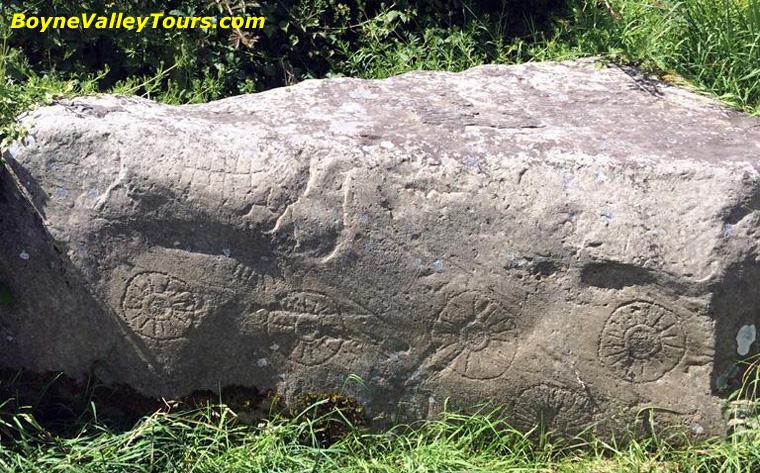
The best known decorated kerbstone at Dowth is Kerbstone 51, often called the Stone of the Seven Suns for its row of rayed circular motifs.
It sits on the eastern side of the kerb and is one of the few carved stones that visitors can usually see clearly.
Low winter light reveals their concentric rings and radial divisions with particular force.
We cannot know whether the Neolithic carver intended these designs as suns. They might have held a very different meaning.
Even so, their modern name encourages us to notice how often circular, radiant, and spiral forms recur at monuments
whose architecture engages with changing light.
Other designs around Dowth include spirals, lozenges, chevrons, and cup marks.
There is less surface art than at Knowth, but Dowth still ranks among Ireland's most important concentrations of Neolithic carving.
Dowth Kerbstone 51, often called the Stone of the Seven Suns.
Visiting Dowth
Dowth's exterior is freely accessible by road from the N51 on the north bank of the Boyne.
There is roadside parking nearby, then a short walk to the mound.
You will not find a visitor center shuttle here, and the chambers remain closed for ordinary visits.
That makes Dowth a useful contrast to Newgrange and Knowth, where timed tickets and official on site guiding are required.
On a private day tour we can include Dowth for atmosphere, landscape, kerbstones, and context,
then continue to other Boyne Valley sites according to your interests and schedule.
TripAdvisor Review
We really enjoyed the trip through the countryside on the way to Newgrange and Dowth. Other stops included the Hill of Slane, Slane Castle, Monasterboice and Mellifont Abbey. One of our best days in Ireland.
Read the full TripAdvisor review