Fourknocks is a quieter 5,000 year old passage tomb near Ardcath and Stamullen in County Meath, about 16 km (10 miles) southeast of Newgrange, where you collect a local key and enter the chamber to see stones decorated with megalithic art, without a visitor center crowd.
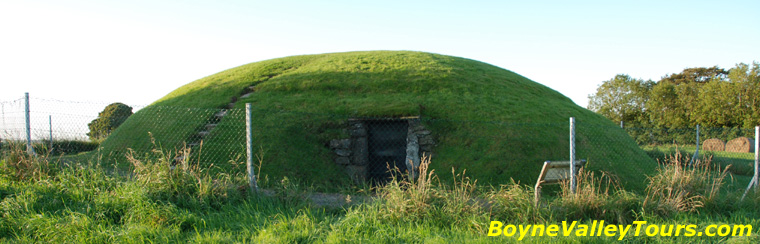
Fourknocks Megalithic Passage Tomb.
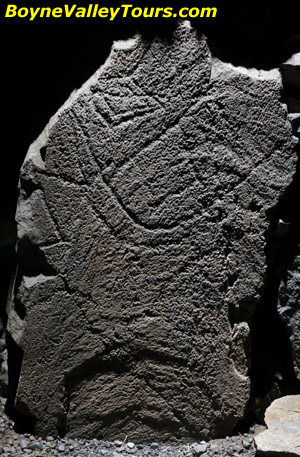
Fourknocks Face Stone.
The name Fourknocks is usually linked with the Irish Fuair Cnoic or Na Fuarchnoic, meaning the Cold Hills.
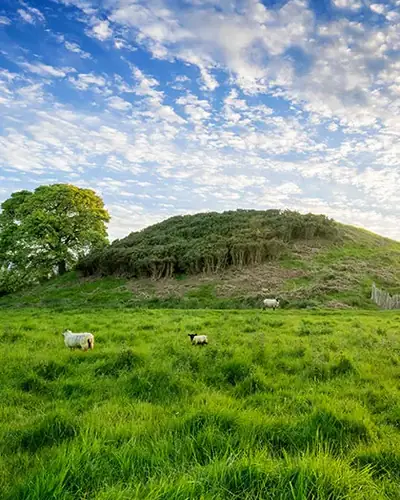
The main mound sits on a ridge overlooking the Delvin Valley, between Ardcath in County Meath and the Naul in County Dublin.
Discover Ireland and Meath County Council both present it as a hidden gem of Ireland's Ancient East: smaller than Newgrange, far less visited, and rewarding if you want time inside the chamber.
Fourknocks I is a cruciform passage tomb. A short passage, about 5 m (16 feet) long, leads into a broad pear shaped chamber with three side recesses.
The central space is roughly 5.5 m by 6.4 m (18 feet by 21 feet), large enough that the carvings can be studied at close quarters.
Excavation found a posthole near the center of the floor, which suggests the original roof may have used an internal timber support rather than a fully corbelled stone dome like Newgrange.
The concrete roof visitors see today was added after excavation in the early 1950s, when the mound was also restored and re-grassed.
Spend a day immersed in Ireland's prehistoric landscape, with more time to appreciate ancient passage tombs, megalithic art, and quieter archaeological sites.
Following official visits to Newgrange and Knowth, the day continues to monuments such as
Dowth and Fourknocks.
Price €700 for up to six guests, plus booking fees. Admission fees are extra.
Fourknocks was not widely known as a major site until the late 1940s, when carved patterns were noticed on a slab in a disturbed mound.
Archaeologist P. J. Hartnett led the main excavation of Fourknocks I for the National Museum in autumn 1950, with further work on nearby mounds in 1951 and 1952.
Meath County Council notes that the tomb contents were unusually intact, which made the results especially valuable for the study of Irish passage tombs.
Fragments representing dozens of burials were recovered, adults and children, both cremated and unburnt.
Grave goods included beads, pendants, bone pins, pottery, and other small ornaments.
The principal finds were removed to the National Museum for protection and study.
Nearby Fourknocks II and III showed further burial activity and later Bronze Age reuse, so the hilltop is best understood as a small cemetery complex rather than a single mound.
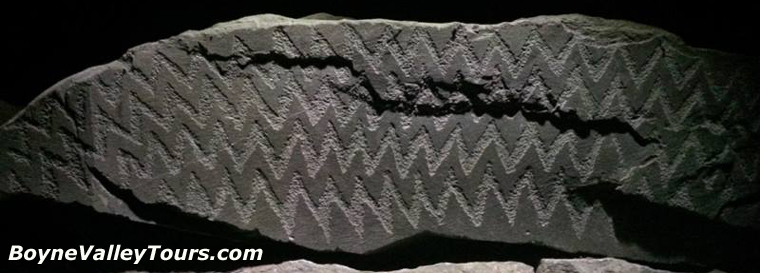
Zigzag megalithic art inside Fourknocks.
Megalithic art and the Face Stone
The chamber is rich in abstract carving: bold zigzags, chevrons, lozenges, concentric circles, and faint spiral motifs on uprights and lintels.
Just inside the chamber, to the left as you enter, stands the Face Stone, about a meter (3 feet) high.
Many visitors read the pattern as a simple human face, and Discover Ireland describes it as one of the few prehistoric representations of a human face in Ireland.
Whether the Neolithic makers intended a face is still debated, but it remains the carving most people remember.
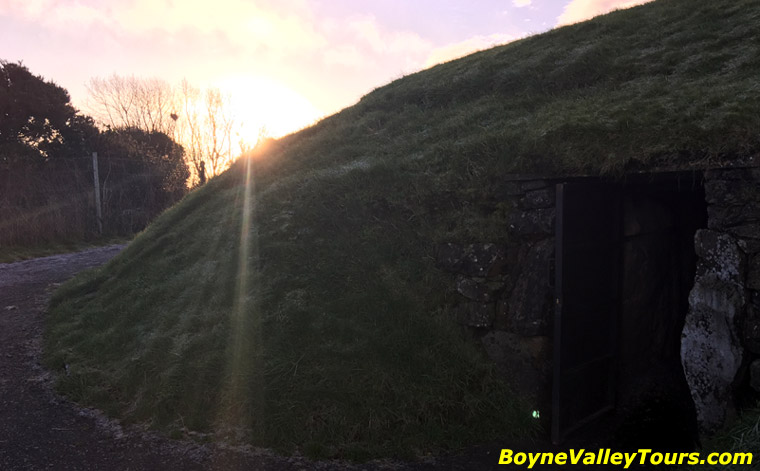
The passage opens toward the northeast.
Some writers, including Martin Brennan, have linked the strong W shaped zigzags with the constellation Cassiopeia.
That reading is interpretive rather than proven, yet it helps explain why people look so carefully at the lintels and side stones once they are inside.
Sunrise at Fourknocks.
Planning a visit
The exterior mound can be viewed at any time, but the chamber door is kept locked to protect the carved stones.
According to Discover Ireland and Meath County Council, the key is held by the White family.
Phone +353 1 835 4722 before 6 pm, leave a refundable cash deposit, and return the key by 6 pm.
Their house is west of the tomb (eircode A42 FN40) and is signposted from Fourknocks.
Bring a flashlight for the chamber. Entry is over a stone stile, so the interior is not suitable for wheelchairs or strollers.
Discover Ireland suggests allowing about 1 to 2 hours for the visit.
On a clear day, views from the mound can stretch as far as the Mourne Mountains.
A private driver-guide can collect the key, bring lighting, and combine Fourknocks with Newgrange, Knowth, Dowth, or the Hill of Tara on a Meath megalithic sites day.
Official timed tours still apply at Newgrange and Knowth inside Brú na Bóinne.
TripAdvisor Review
Michael was very personable and knowledgeable. He took us to Fourknocks, which is like Newgrange but less commercialized, and also to high crosses, Mellifont Abbey and the Battle of the Boyne.
Read the full TripAdvisor review