Monasterboice is an early Christian settlement associated with St. Buithe, known for its round tower and high crosses.
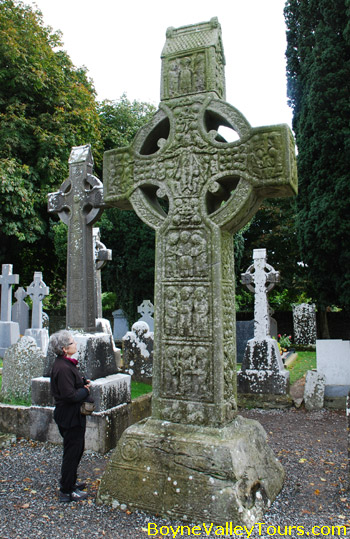
The site is best known for its remarkable high crosses, including Muiredach’s Cross, widely regarded as one of the finest in Ireland,
with detailed carvings depicting biblical scenes.
Monasterboice,
originating from the Irish 'Mainistir Bhuithe' (monastery of Buite), stands as one of Ireland's earliest Christian sites.
St. Buite, an Irish monk and devoted disciple of St. Patrick, is a central figure in its history.
Legend has it that in the year 480, during his journey back from Rome, St. Buite performed a miraculous
feat by raising Nechtan Morbet, the King of Pictland (Scotland), from the dead.
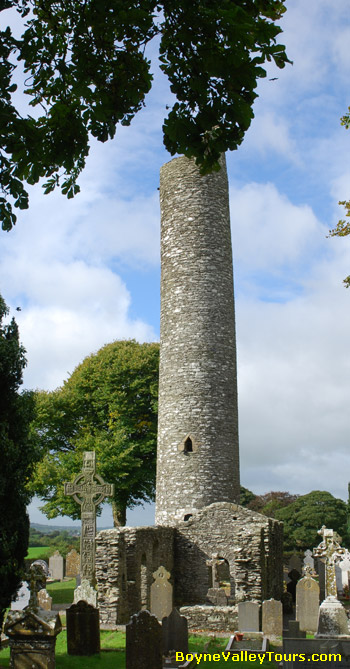
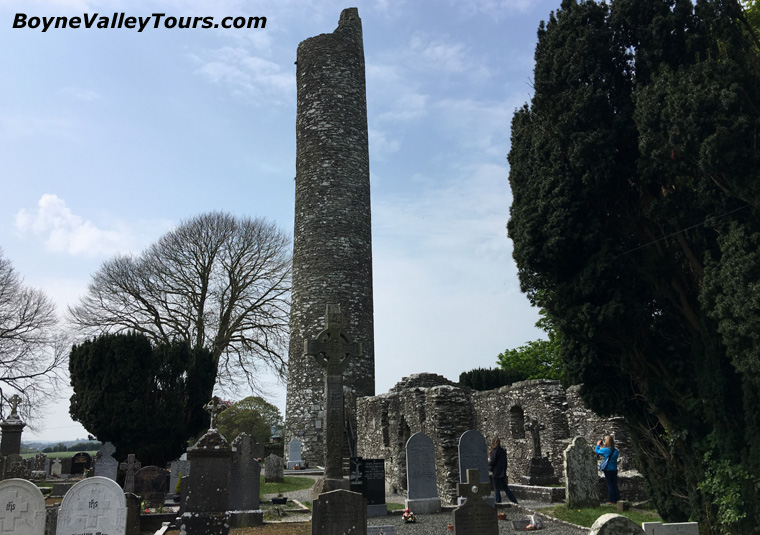
Monasterboice round tower with high cross.
On a private Boyne Valley day tour, your driver-guide can take you through Monasterboice to see the Round Tower, the splendid High Crosses, and the remnants of two churches.
The site pairs well with nearby Mellifont Abbey and the medieval gateway town of Drogheda.
While initially believed to have functioned as refuges from Viking raids, round towers,
indicated by the Irish term 'cloic theach' meaning a bell house, also served the purpose
of bell towers. In 1097, the tower at Monasterboice fell victim to a destructive fire
that consumed the monastic library and valuable treasures. Despite this setback,
the tower remains remarkably well-preserved, albeit missing its conical cap.
The Vikings occupied the site for a period until they were routed by Domhnall, King of Tara, in 968.
Following this, St. Buite's monastery continued to serve as a vital hub for spirituality
and education for numerous centuries, maintaining its prominence until the establishment of Mellifont Abbey nearby in 1142.
Monasterboice boasts two of Ireland's most exceptional High Crosses (Celtic Crosses)
- the South Cross (or Cross of Muiredach) and the West Cross (or Tall Cross) - both dating
back to the 10th century. Crafted from sandstone, these crosses exhibit intricate carvings
illustrating scenes from the Old and New Testaments. Today, the image of the High Cross
holds global recognition, transcending its religious significance to become a symbol of Ireland's rich cultural heritage.
Designed for visitors who enjoy medieval history, atmospheric ruins, and photography, this private Boyne Valley tour explores castles, abbeys, and early Christian monuments.
Stops include Ireland's largest Anglo-Norman fortress at Trim Castle,
the monastic ruins of Mellifont Abbey and Bective Abbey,
and the high crosses at Monasterboice.
The day can also include the Hill of Slane and Slane Castle when available.
Price €700 for up to six guests, plus booking fees. Admission fees are extra.
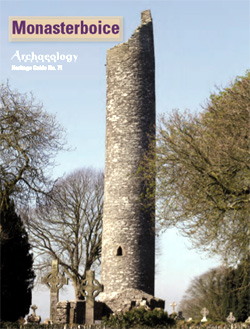
This short, well produced guide is the best companion for a visit to Monasterboice.
Written by Conleth Manning, Senior Archaeologist with the National Monuments Service, it draws on a lifetime of work on Ireland's Early Christian and medieval monuments.
Archaeology Ireland published it in December 2015 as Heritage Guide No. 71, with support from Louth County Council and the Heritage Council.
Manning sets the scene clearly. Monasterboice was founded by Saint Buite, who died about AD 520, and the name comes from Mainistir Bhuithe, the monastery of Buite.
The site appears often in the Irish annals from the early eighth century to the twelfth, and later faded as nearby Mellifont Abbey rose to prominence.
What remains in the graveyard today is still remarkable. There are two ruined churches, a round tower about 30 meters (about 100 feet) high and three high crosses.
The guide is especially strong on the sculpture. Muiredach's Cross stands about 5 meters (about 17 feet) tall and is carved all over with biblical scenes, including the Crucifixion and the Last Judgement.
An Irish inscription links it with a Muiredach who died in 924.
The Tall Cross, also called the West Cross, rises to about 7 meters (about 23 feet) and is again covered in carved scenes.
Together they are among Ireland's finest high crosses, and the guide explains their iconography, dating (likely between about 850 and 920), and artistic importance with clear maps and photographs.
It also covers the round tower, burned in 1097 "with its books and many treasures," the North and South churches, early grave-slabs, and the wider early medieval settlement beyond the present graveyard wall.
If you want to understand what you are looking at before or after your visit, this is the guide to download.
Monasterboice, Co. Louth in Ireland's Ancient East.
Monasterboice, A Powerful Place
From a distance, the first you see of Monasterboice is a tall round tower,
jagged at the top, missing its original conical roof. The round tower
pokes up above the surrounding countryside, announcing, "Here is Monasterboice."
Irish round towers, associated with monastic complexes, were built as belfries and
to shelter inhabitants and valuables during Viking raids. Their doorways are often
set well above the ground. Entry is only possible by ladder,
which could be drawn up in times of danger. Unfortunately, that strategy did not
prevent Monasterboice's tower from being burned in 1097, along with the
monastery's library and other treasures.
St Bhuithe (died 521CE) founded Monasterboice, hence the name, derived from
Mainistir Bhuithe. The oldest monuments that survive are the three High Crosses
and the round tower, which date from the tenth century. After the Cistercian
abbey at Mellifont was established in 1142, Monasterboice was abandoned. A
parish church was established on the site in the thirteenth century, and the
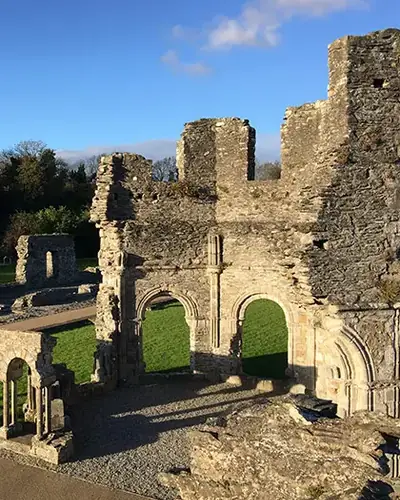
remains of two small churches can still be seen.
High Crosses are found in both Britain and Ireland, but they are more
numerous and much more finely carved in Ireland. Over 300 survive in Ireland.
Along with their height, their distinctive feature is the ringed crosshead. The
decorated ring or wheel that surrounds the center of the cross supports the
weight of the center and the extended arms. It also brings a touch of Celtic
spirituality to the Christian form, reminding us of the cycles of seasons and of
the cycle of life and death and rebirth and of unity and perfection.
Muiredach's High Cross at Monasterboice.
Irish High Crosses were carved between the eighth and twelfth centuries. Early
crosses were decorated with simple geometrical reliefs, but in the ninth and
tenth centuries biblical scenes were introduced, meant to be "read" in a
particular order, usually from the ground up.
Interlaces, geometrical motifs,
entangled creatures, what we often think of as "Celtic" art is derived from the
style found all across northern Europe, Germany, Scandinavia and Anglo-Saxon
England. It is quite possible that the High Crosses were originally colored or
brightly painted. Although the scenes carved on the High Crosses may have been
edifying "sermons in stone", similar to the "sermons in glass" found in
stained-glass windows, the High Crosses were also status symbols for the
monasteries and their patrons.
Monasterboice has three High Crosses, two of which are quite impressive. The
South or Muiredach's Cross is about 5 meters (about 17 feet) high and is one of the most
perfect in Ireland, a true national treasure. It is named after an abbot,
probably Muiredach mac Domhnaill, who died in 924 and is commemorated in
carving on the base. It is carved from a single block of sandstone attached to a
pyramidal base; a decorative sandstone capstone sits on top. The entire surface
of Muiredach's Cross is covered with ornate designs based on an underlying
geometrical grid-a way in which the skilled stone carvers gave visual
representation to the geometrical matrix that underlies reality.
Detailed figural sculptures of biblical stories (both Old and New Testaments) decorate
the cross on the east and west sides; geometric and interlace ornamentations are
carved on the narrower north and south sides. A series of zodiacal figures adorn
the base. Its capstone is a tiny roofed building or miniature oratory, perhaps
representing a reliquary. It includes a depiction of St. Paul and St. Anthony in
the (Egyptian) desert.
The east side of Muiredach's cross, as is usual for High Crosses, focuses on
images from the Old Testament. It begins at the base with a scene from the
Garden of Eden, then moves up to Cain and Abel, David and Goliath, Moses, and
the Magi. Within the wheeled center and extending through both arms is Christ at
the Last Judgment. According to Nigel Pennick, this image is "based on the
iconography of the resurrected Egyptian god, Osiris. Christ is holding a cross
and Irminsul-staff in the Osirian position, and on his head is an eagle that
resembles the crown of Egyptian gods and pharaohs". Pennick interprets the
figure to the left of Christ as Pan with his pipes, the harp-playing figure on
the right as either King David or Apollo.
Monasterboice Round Tower and High Cross.
The west side is devoted, more or less, to the life of Christ, beginning at the
base (above the inscription and some charming Celtic cats) with his arrest at
Gethsemane and continuing upward to his crucifixion (complete with soldiers
mocking Christ) and then his Resurrection. On the north side, under the
outstretched cross-arm, is a depiction of the Hand of God (Dextera Dei) with a
nimbus of power behind it, above intertwining vines with human heads.
The West Cross or Tall Cross stands near the north church and the round tower.
It is about 7 meters (about 23 feet) high, among the tallest High Crosses in Ireland. It
also is covered with biblical scenes, though they are badly eroded. On the east
side of the crosshead is a carving of David killing a lion with a hurley stick
and ball-the earliest depiction of the game in Ireland. The west side includes
another crucifixion scene. The North Cross, which has been heavily
reconstructed, stands to the north, next to what remains of an old stone sundial.
Monasterboice is in a delightful rural setting, surrounded by a low stone wall
and numerous trees. It is neither neglected nor over-developed. There is no
charge for entry. Visiting Monasterboice is like discovering a new friend but
one that you feel you have known for a long, long time, and one that you look
forward to seeing again.
Monasterboice is indeed a Powerful Place.
Irish High Crosses - An illustrated lecture by Dr. Peter Harbison.
TripAdvisor Reviews
My family of three had a great day touring the Boyne Valley with Michael Fox.
I asked Michael to include visits to Mellifont Abbey, Monasterboice, Kells, Loughcrew Cairns, Trim Castle, Bective Abbey, and the Hill of Tara.
I didn't expect to be able to get to them all, but he made it happen.
Read the full review
We felt a connection to the past while we lingered alone inside the Newgrange chamber.
After hearing about our interests, Michael took us to Dowth, Fourknocks, and the crosses and round tower at Monasterboice.
His knowledge of the Boyne Valley is second to none. It's like having your best friend show you around.
Read the full review