The Winter Solstice sunrise at Newgrange is world famous.
Less well known is the matching late afternoon event at Dowth, where Dowth South faces southwest
and is aligned to the setting sun around midwinter.
Together the two mounds frame the shortest day of the year in Brú na Bóinne: light entering from the southeast at dawn,
and light returning from the southwest before night.
On 21 December 2015, after a wet morning at Newgrange, the afternoon cleared enough for sunshine at Dowth.
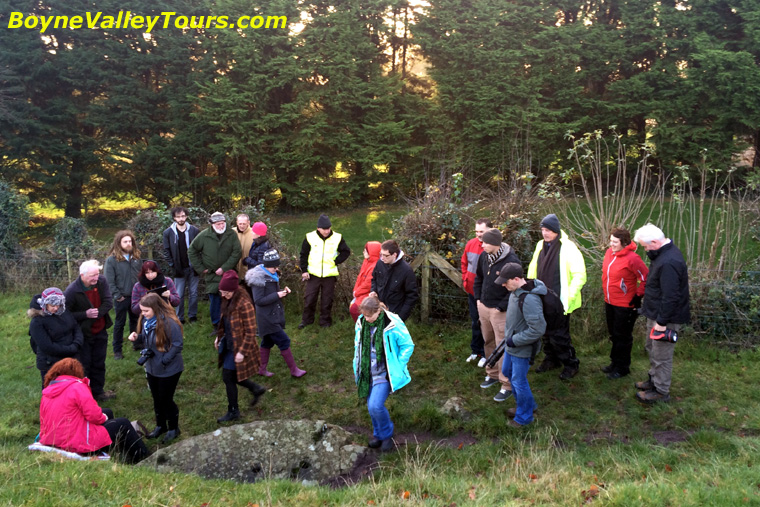
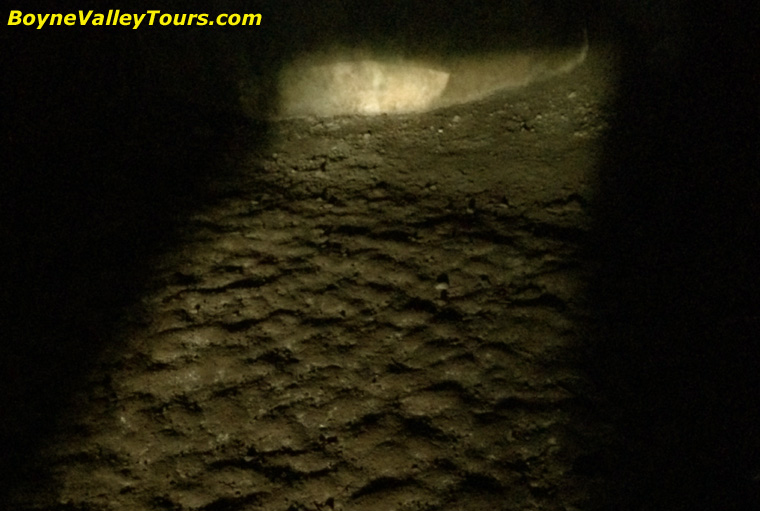
Entering the chamber at Dowth - 21 December 2015.
Dowth South has a short passage of about 3.5 meters (11.5 feet) leading to a circular chamber with a single recess to the right.
A sill stone marks the step from passage into chamber. The original roof collapsed long ago and was replaced with concrete,
so the tomb feels different from Newgrange's intact corbelled chamber, yet the solar idea is the same:
low winter light is invited deep into a carefully oriented stone passage.
Weather and Expectations
For many years evergreen trees west of the mound grew into the sightline and often blocked or fragmented the solstice beam,
so even on a clear evening the sun sometimes had to find a gap between trunks and branches.
Those trees have now been cut, restoring a clearer western horizon for the sunset alignment.
Cloud cover can still cancel the event entirely, so a successful illumination remains weather dependent
rather than a guaranteed show simply because the calendar says 21 December.
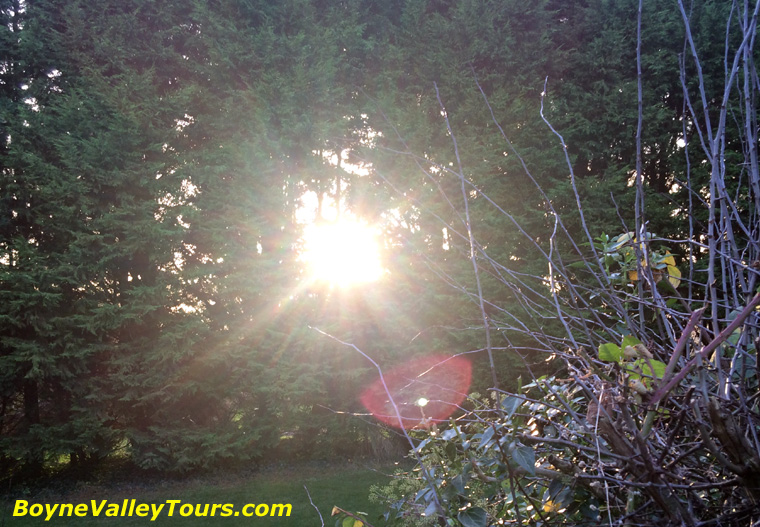
Setting sun through the trees at Dowth - 21 December 2015.
How the Sunset Light Enters
On clear evenings near 21 December, the low sun can enter above the entrance kerbstone and under the lintel,
cross the sill, and reach the rear of the chamber.
Observers from Martin Brennan and Jack Roberts in 1980 through Anne-Marie Moroney's winter studies from the late 1990s
have described a beam that moves through the space over a longer period than Newgrange's brief dawn flash,
often lasting on the order of about two hours under good conditions before it withdraws.
Exact clock times vary with the year and local sunset, but the event belongs to the late afternoon,
commonly around 3 pm into the period approaching sunset.
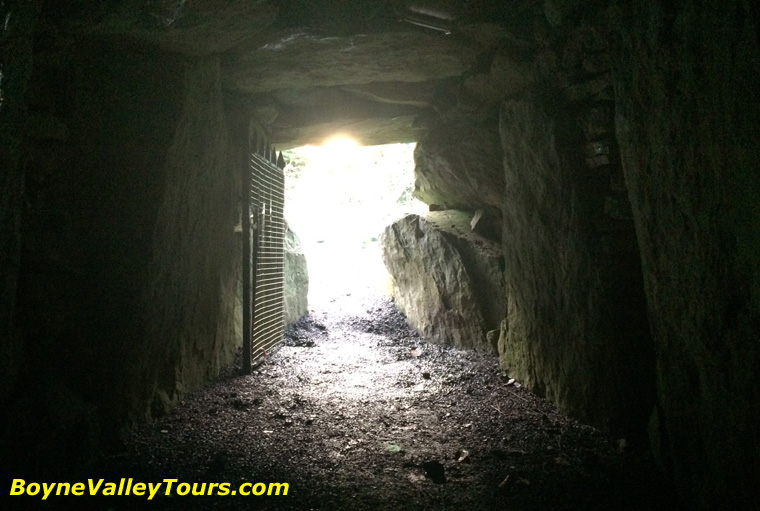
Setting sun entering the passage at Dowth - 21 December 2015.
The strongest effect is around the solstice, yet Dowth South can admit winter sunlight across a wider season
when the sun sets far enough south, often described from late autumn into early spring.
As the weeks move toward and away from midwinter, the path of the beam shifts across the stones.
Reflected light can also reach decorated surfaces in the recess, so the spectacle is not only a floor beam
but a changing play of light on the chamber walls.
Sunbeam in the chamber at Dowth - 21 December 2015.
Rediscovery and Study
Interest in Dowth's winter sunset was brought back into public view around 1980, when Brennan, Roberts, and others observed and recorded sunlight in Dowth South.
Their work was widely reported and later published, though some archaeologists cautioned that later roof and entrance repairs make exact prehistoric precision harder to prove.
From 1997 onward, Anne-Marie Moroney made detailed winter observations and photographs, mapping how the light moves through the chamber
and documenting how trees then obstructed the beam. Her research remains a key modern record of the phenomenon.
Dowth North, the larger western tomb, has been linked in research to other possible sunset or lunar orientations around the cross-quarter days of Samhain and Imbolc.
Those ideas are still debated and should be treated as hypotheses, not as a settled visitor fact like the better attested winter sunset at Dowth South.
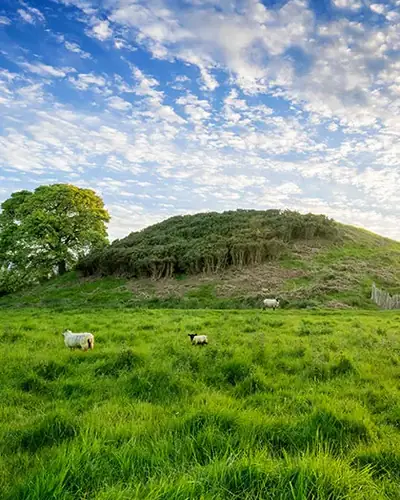
Dowth Megalithic Passage Tomb | Brú na Bóinne.
Visiting for the Solstice
The exterior of Dowth is freely accessible year round from the north bank of the Boyne, near the Slane to Drogheda road.
It is not on the ticketed Brú na Bóinne Visitor Center tour that serves Newgrange and Knowth.
The chambers are normally locked for safety. On some years the OPW opens Dowth South for a short afternoon window on 21 December,
often around 2:30 to 4:00 pm, weather permitting. Arrangements change, so check current OPW or Brú na Bóinne notices before you travel.
When the chamber is closed, you can still walk the mound, look for kerbstones, and watch the sun set on the western horizon.
Spend a day immersed in Ireland's prehistoric landscape, with more time to appreciate ancient passage tombs, megalithic art, and quieter archaeological sites.
Following official visits to Newgrange and Knowth, the day continues to monuments such as
Dowth and Fourknocks.
Price €700 for up to six guests, plus booking fees. Admission fees are extra.
My wife and I toured the Boyne Valley with Michael, and it was the highlight of our trip to Ireland. We would rate him as first class and look forward to another tour next time.
Read the full TripAdvisor review