Newgrange Folly
Standing immediately behind the great passage tomb, the Newgrange Folly is a small garden building erected in the early 19th century. Its doorway, sloping stone walls and circular openings give it the appearance of a miniature romantic ruin. Although far younger than Newgrange, it forms part of the monument’s later history.
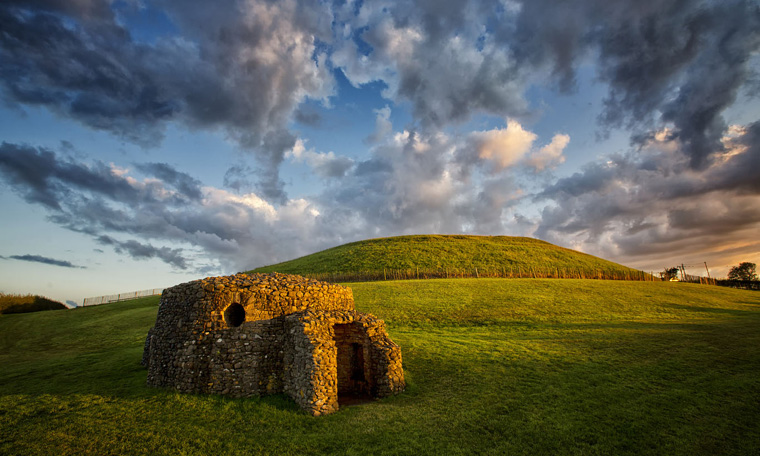 The early-19th-century Newgrange Folly, with the passage tomb rising behind it.
Why Was the Folly Built?
A folly is an ornamental building created mainly to enliven a landscape rather than to serve an essential practical purpose. Such structures were fashionable additions to estates during the 18th and 19th centuries, often designed to resemble ruins, temples or small towers. The identity of the person who commissioned the Newgrange example, its exact construction date and its intended use are not documented.
Archaeological accounts agree on one important point: the folly was made with stones removed from Newgrange. It is therefore evidence of an era when ancient monuments were not protected or conserved to modern standards. Stone was also taken from prehistoric sites for roads, field clearance and other building work, while visitors and antiquarians sometimes disturbed their fabric during exploration.
What the Building Looks Like
The low, roughly built structure has sloping exterior walls, a narrow doorway and two distinctive circular openings. Its compact scale and deliberately picturesque appearance distinguish it from the nearby prehistoric tombs. Seen against the enormous grass-covered mound, the folly creates a striking contrast between a 19th-century landscape ornament and a monument constructed more than five millennia ago.
Part of Newgrange’s Later Story
Newgrange was already attracting antiquarian interest long before the folly was constructed. The passage and chamber became accessible again in 1699 when labourers removing material from the mound exposed the entrance. During the 18th and 19th centuries, scholars surveyed the monument and recorded its carvings, but this growing interest existed alongside damaging practices such as quarrying stone and cutting names into the ancient stones.
The folly is not a prehistoric satellite tomb and should not be confused with the smaller Neolithic monuments surrounding Newgrange. It is a comparatively modern feature, but it helps illustrate changing attitudes to archaeology: material once removed for decoration would now be protected as part of the nationally and internationally important landscape of Brú na Bóinne.
Seeing the Folly
The folly can be seen during an official visit to Newgrange. All visits to Newgrange begin at the Brú na Bóinne Visitor Centre near Donore; visitors are taken to the monument by shuttle bus and access is by guided tour only. Tickets are limited, so advance booking is strongly recommended. The structure is best appreciated as one small chapter in the much longer history of the Newgrange landscape.
Newgrange Passage Tomb
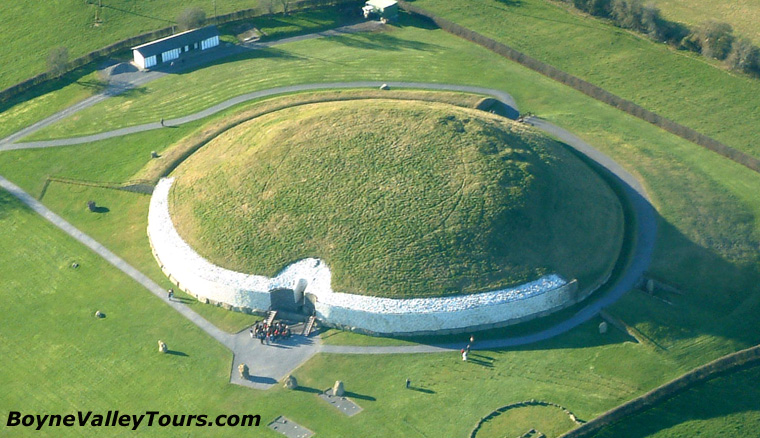 Aerial view of Newgrange in the Boyne Valley.
Newgrange was constructed around 3200 BC during the Neolithic period. The large circular mound encloses a stone-lined passage leading to a cruciform chamber with a corbelled roof. Ninety-seven kerbstones surround the mound, and many stones within the monument bear carved geometric designs.
Archaeologists classify Newgrange as a passage tomb, although burial was only one aspect of its significance. Its monumental scale, elaborate art and solar alignment indicate that it also had important ceremonial and symbolic roles for the communities that built and used it.
The passage and chamber is aligned with the rising sun on the mornings around the winter solstice. It is the best known monument within the Brú na Bóinne complex, alongside the passage tomb mounds of Knowth and Dowth, and as such forms part of the Brú na Bóinne UNESCO World Heritage Site. Newgrange also shares many similarities with other passage tombs in Western Europe, such as Gavrinis in Brittany, Maeshowe in Orkney and Bryn Celli Ddu in Wales.
The entrance became accessible again in 1699 after labourers removing material from the mound exposed the passage. Archaeological excavation directed by Michael J. O’Kelly began in 1962, followed by conservation and reconstruction work that included the present quartz-and-granite facing at the front of the mound.
The Neolithic people who built the monument were farmers, growing crops and raising animals such as cattle in the area where their settlements were located. They had not yet developed metal, so all their tools would have been made out of stone, wood, antler or bone.
Sources and Further Reading
The folly is identified in the Brú na Bóinne World Heritage Site Management Plan. Its early-19th-century date and construction from stone removed from Newgrange are discussed in Geraldine and Matthew Stout’s Newgrange and Michael J. O’Kelly’s Newgrange: Archaeology, Art and Legend.
TripAdvisor Review
Michael was an incredible host and provided so much history and lore to the sites we visited. We learned about the abbeys, Celtic crosses, castles, passage tombs and many other topics. Read the full TripAdvisor review