Moylagh lies on a low ridge in northwest County Meath, about 8 km (5 miles) from Oldcastle and close to the
Loughcrew Cairns.
It is a quiet roadside site where two groups of medieval ruins occupy neighbouring mounds:
the fragmentary remains of Moylagh Castle and, nearby, a medieval church with a substantial fortified western tower.
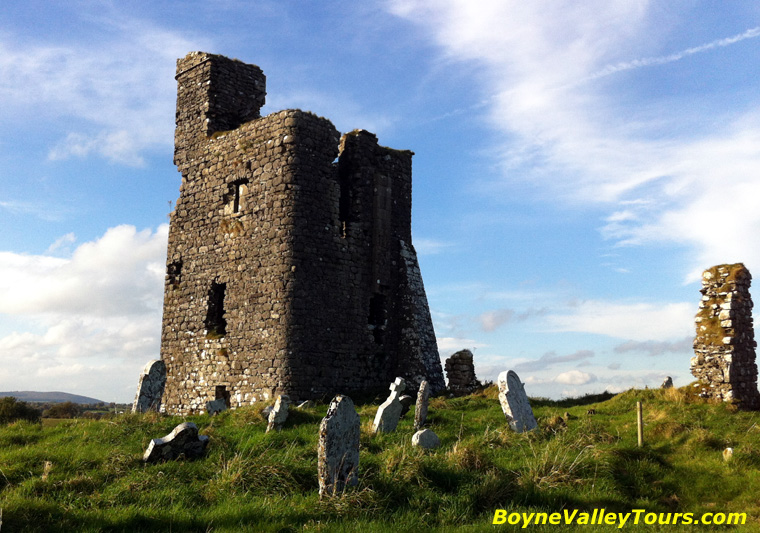
Moylagh fortified church tower and graveyard.
Visiting Moylagh
There is no visitor center or ticket office. The ruins stand in open farmland and can be viewed from the public road,
with pedestrian gates set into the stone field walls for access to the tower and graveyard.
A short climb brings you to the fortified church tower, the best-preserved standing structure.
The castle motte on the opposite hill is fenced and is best viewed from outside the boundary wall.
The graveyard around the tower was in use into the 20th century. Treat the site with respect, especially where headstones
are leaning or weathered. Wear sensible shoes, as paths are grassy and uneven.
Pair a stop here with Loughcrew or a drive through the lakes and drumlins around Oldcastle.
What You Will See
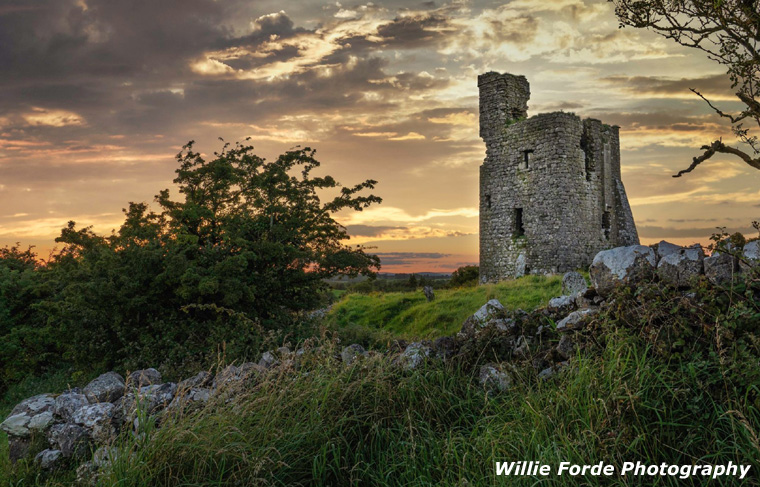
The landmark most visitors photograph is the fortified western tower of the medieval church.
Although it is often called a tower house or even Moylagh Castle, historical drawings and surveys identify it as part of the church complex.
Its fireplace, latrine, bed recess and window seats show that it was also designed for habitation and defense.
The tower has rounded corners and survives as a shell, while low walling and foundations mark the adjoining body of the church.
Its precise date is uncertain: it is generally assigned to the later medieval period, and a documentary record notes assistance for the construction of a tower near Moylagh Castle in 1470.
On the neighbouring motte stand the fragmentary remains of the separate Barnewall castle.
The Down Survey of the 1650s described a ruinous castle with a bawn, or defended enclosure.
Today mainly the buttressed north wall survives, about 8 meters (26 feet) high, with scars in the masonry showing where other buildings once joined it.
The castle sits on a Norman motte and commands wide views over the surrounding farmland.
Moylagh fortified church tower and adjoining church ruins. Photo by Willie Forde Photography.
Layers of History
Archaeological evidence at Moylagh goes back well before the Normans.
A large ringfort with defensive banks may have enclosed an early medieval settlement.
Other earthworks have encouraged suggestions of an ecclesiastical settlement, although this interpretation remains uncertain. The ridge lies within the wider prehistoric landscape of
Loughcrew, where great Stone Age cairns crown the hilltops a few kilometres away.
Anglo-Norman settlers arrived in the 1170s and raised a motte and bailey, the classic earthwork mound with an attached bailey yard.
A timber fortification probably occupied the motte before the later stone castle.
Moylagh was subsequently associated with the Barnewall family, whose name also appears as Barnwall and Barnewell in historical sources.
The church tower belongs to a period when important religious buildings were sometimes fortified and also provided accommodation.
A possible connection with the Benedictine priory at Fore has been suggested, but is not firmly established.
Calling the tower a “tower house” describes its residential and defensive features, but can obscure its function: it formed part of the church and was not the separate castle on the neighbouring motte.
The Civil Survey of 1654 to 1656 records Sir Richard Barnwall of Crickstown holding about 74 hectares (182 acres) at Moylagh in 1640,
including the ruinous castle and bawn, a church with a steeple tower, and about twenty cabins, signs of a small settlement on the ridge.
Local accounts also refer to a later church in a field to the north during the late 18th century.
The graveyard tells more recent stories. Local tradition remembers Brian McCormick, known as Brianbawn, a huntsman said to have been buried
facing Grennan Hill so he could always watch the chase.
During the Great Famine many people who died in Oldcastle workhouse were buried here.
In 2012 the Moylagh Historical Society erected a memorial to those famine burials, and their booklet remains a useful guide to the site.
Designed for visitors who enjoy medieval history, atmospheric ruins, and photography, this private tour explores castles, abbeys, and early Christian monuments.
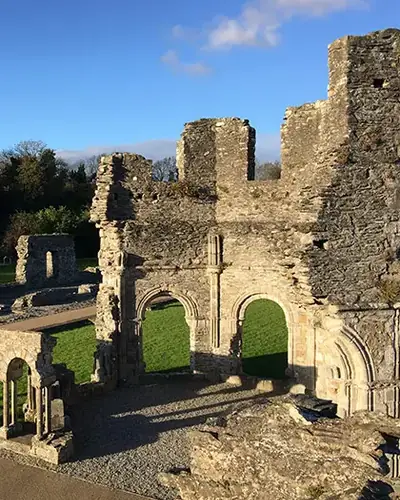
Stops include Trim Castle, Mellifont Abbey, Bective Abbey,
and the high crosses at Monasterboice.
Custom itineraries can extend northwest to Moylagh, Loughcrew, and Fore Abbey.
Price €700 for up to six guests, plus booking fees. Admission fees are extra.
Loughcrew Cairns are the obvious companion visit, with equinox alignments and some of Ireland's finest passage tomb art.
Oldcastle is the nearest town for fuel and supplies.
Fore Abbey, with its seven wonders and medieval ruins, lies a short drive to the northwest in County Westmeath and makes a strong half-day pairing with Moylagh.
TripAdvisor Review
Fantastic private tour to the amazing megalithic passage tomb at Newgrange, the Bru na Boinne visitor centre, the Hills of Tara and Slane and other sites. Having grown up in this area, Michael brings it to life.
Read the full TripAdvisor review