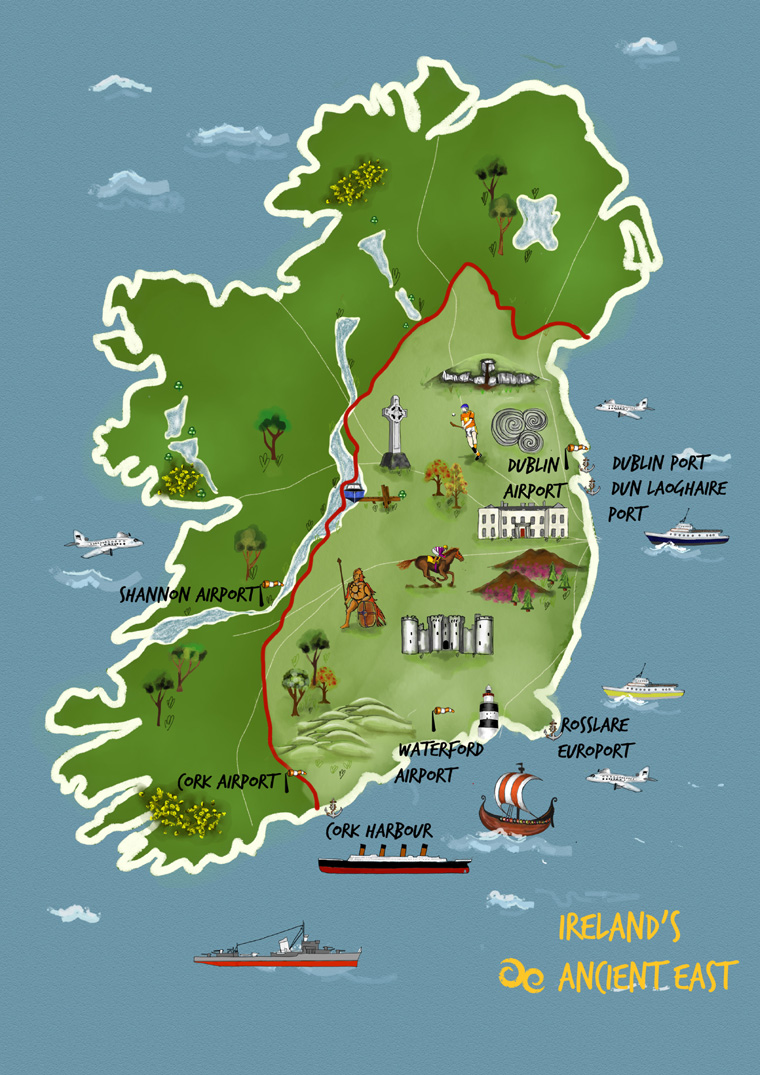
Ireland’s Ancient East brings together historic landscapes, lively towns, gardens, walking routes and coastal scenery across the east and southeast of Ireland.
Use this map as an introduction to a region stretching from the Boyne Valley and Newgrange in the northeast,
through Wicklow and the Midlands, to Kilkenny, Waterford, Wexford and parts of the southern counties.
Ireland’s Ancient East visitor map.
Created by Fáilte Ireland as a regional tourism brand, Ireland’s Ancient East connects places through more than 5,000 years of history.
It is not one fixed driving road like the Wild Atlantic Way. It is a broad touring region in which visitors can build their own itinerary around archaeology,
monastic heritage, castles, historic houses, gardens, crafts, food, outdoor activities and the coast.
The distances shown on a map can be deceptive because many attractions require time for guided visits and country-road travel.
For a rewarding journey, concentrate on one area each day: the Boyne Valley; Wicklow and Glendalough; Kilkenny and the Nore Valley; Waterford and the Copper Coast;
or Wexford and the Hook Peninsula. Opening seasons, tour availability and access arrangements vary, so check official attraction websites before travelling.
Boyne Valley and Ireland’s Ancient North-East
The Boyne Valley is the natural starting point for exploring Ireland’s prehistoric past. At the UNESCO World Heritage Property of
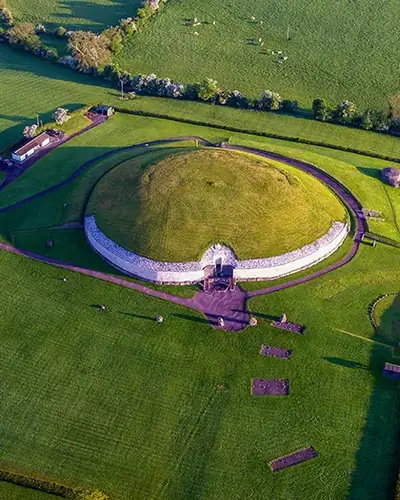
Brú na Bóinne, the great passage tombs of Newgrange, Knowth and Dowth
stand within a landscape containing dozens of recorded prehistoric monuments. Newgrange is renowned for the winter-solstice sunrise entering its passage and chamber,
while Knowth preserves an exceptional concentration of megalithic art.
Visits to Newgrange and Knowth begin at the Brú na Bóinne Visitor Centre near Donore. Visitors travel to the monuments by shuttle bus and join tours led by official guides;
advance booking is essential because daily capacity is limited. Elsewhere in County Meath, Loughcrew Cairns occupy exposed hilltops near Oldcastle,
while the Hill of Tara preserves earthworks and monuments associated with ritual, burial and Irish kingship over many centuries.
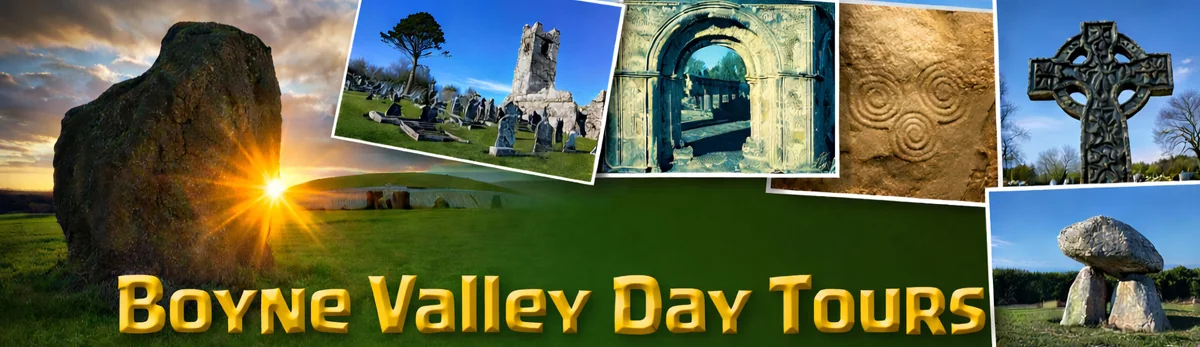
Ideal for a first visit to the Boyne Valley, this private tour explores the UNESCO World Heritage landscape of Brú na Bóinne.
Visit Newgrange and Knowth with the official site guides,
then discover places associated with Ireland's ancient kings, mythology, and Saint Patrick.
The day also includes the Hill of Slane and the Hill of Tara.
Price €700 for up to six guests, plus booking fees. Admission fees are extra.
The same landscape also tells the story of medieval Ireland. Trim Castle, begun by Hugh de Lacy and his successors after the Anglo-Norman arrival,
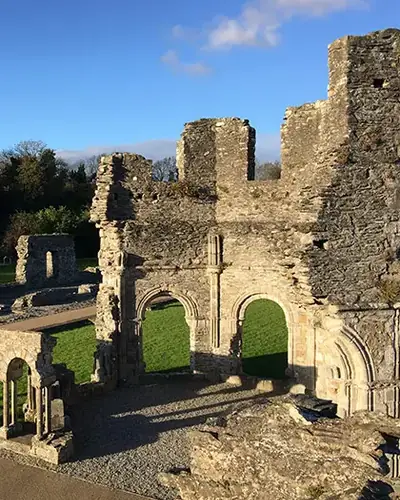
is the largest Anglo-Norman castle in Ireland. The ruins of Old Mellifont Abbey, founded in 1142, mark the first Cistercian foundation in Ireland,
while the high crosses and round tower at Monasterboice preserve the artistry of an earlier Christian tradition.
Designed for visitors who enjoy medieval history, atmospheric ruins, and photography, this private tour explores castles, abbeys, and early Christian monuments.
Stops include Trim Castle, Mellifont Abbey, Bective Abbey,
and the high crosses at Monasterboice.
Custom itineraries can extend northwest to Moylagh, Loughcrew, and Fore Abbey.
Price €700 for up to six guests, plus booking fees. Admission fees are extra.
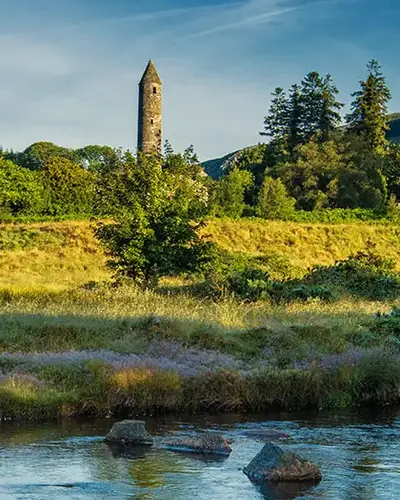
Monastic sites are among the defining experiences of Ireland’s Ancient East. At Glendalough,
tradition associates the foundation of the monastery with Saint Kevin in the sixth century. The surviving “Monastic City” includes a round tower,
medieval churches, decorated crosses and gateways in a glaciated valley containing two lakes. The archaeological site can be combined with lakeside walks or longer routes in Wicklow Mountains National Park.
On the River Shannon, Clonmacnoise developed from a monastery traditionally founded by Saint Ciarán in the sixth century into an important religious and political center.
Its churches, round towers, high crosses and grave slabs reflect centuries of patronage and craftsmanship. In the Boyne Valley, the
Hill of Slane is traditionally associated with Saint Patrick’s Paschal fire, although the familiar account belongs to later hagiographic tradition rather than contemporary evidence.
Later monasteries reveal changing religious architecture. Jerpoint Abbey in County Kilkenny is celebrated for its Romanesque and Gothic fabric and carved cloister arcade;
Tintern Abbey in County Wexford occupies a wooded landscape close to the Hook Peninsula; and the Rock of Cashel in County Tipperary brings together a round tower,
Romanesque chapel, Gothic cathedral and later buildings on a commanding limestone outcrop.
Travel through the Wicklow Mountains to Glendalough, combining dramatic scenery with one of Ireland's most important early Christian settlements.
The route follows the Sally Gap scenic drive, with views over Lough Tay (the Guinness Lake),
before continuing to the monastic settlement at Glendalough, founded in the 6th century by Saint Kevin.
Price €700 for up to six guests, plus booking fees. Admission fees are extra.
Waterford and Kilkenny make a strong pairing for visitors interested in urban history. Waterford was established as a permanent Viking settlement in 914 and describes itself as Ireland’s oldest city.
Its compact Viking Triangle contains Reginald’s Tower, the Medieval Museum, the Bishop’s Palace and other visitor experiences that trace the city from its Norse beginnings through later centuries.
Kilkenny’s Medieval Mile links Kilkenny Castle with the historic center around St Canice’s Cathedral. Along the route are medieval lanes,
merchant houses, churches and the Medieval Mile Museum. Kilkenny Castle developed from a medieval fortress into the principal Irish residence of the Butler family,
and its restored rooms and parkland provide a contrast with the city’s narrower medieval streets. County Kilkenny is also noted for contemporary craft and design.
See what awaits you in Ireland’s Ancient East.
Great Houses, Gardens and Revolutionary History
The region’s 18th- and 19th-century houses and gardens illuminate the wealth, taste and inequalities of the landed-estate era.
Major visitor destinations include Powerscourt and Mount Usher in Wicklow, Castletown in Kildare, Emo Court in Laois, Altamont Gardens in Carlow,
Mount Congreve in Waterford and Lismore Castle Gardens. Each has its own access arrangements, and some historic houses are seasonal even when their parklands remain open.
The political and social history of the period is equally visible. Vinegar Hill overlooks Enniscorthy, a principal battlefield of the 1798 Rebellion;
Wicklow Gaol interprets imprisonment and transportation; and the Dunbrody Famine Ship Experience at New Ross explores emigration during the Great Famine through a reconstructed emigrant vessel and visitor exhibition.
These attractions add human stories to an itinerary otherwise dominated by monumental architecture.
Coast, Landscapes and Active Touring
Ireland’s Ancient East is not solely a heritage trail. The Wicklow Way crosses mountain and forest landscapes; the Barrow Way follows the historic navigation;
and the 46 km (29 miles) Waterford Greenway uses a former railway corridor between Waterford City and Dungarvan. On the Hook Peninsula, Hook Lighthouse stands at the entrance to Waterford Harbour,
while Wexford’s long beaches and nature reserves offer a different pace from castles and museums.
Rather than trying to cover the full map in one outing, a private tour lets you concentrate on one rewarding area each day.
A Boyne Valley day tour can include Newgrange, Knowth and related historic sites;
a Wicklow tour can combine Glendalough with mountain scenery;
and longer stays allow for Kilkenny, Waterford City, the Greenway and the coast over two or more days.
Your itinerary is planned around opening times, guided-site access and seasonal arrangements, with hotel or cruise pickup included.
TripAdvisor Review
My daughter and I had a wonderful day. Michael Fox was so informative and showed us so much. It was a powerful day and gave us a new sense of pride in our Irish heritage.
Read the full TripAdvisor review