Ardmulchan Church and Cemetery
Ardmulchan sits on one of the finest bends of the River Boyne between Navan and Slane. The Irish name is usually read as the height or hill of Maelchu. From the walled graveyard the valley opens out in both directions, with fertile pastures, woodland, and the river curling below the ridge.
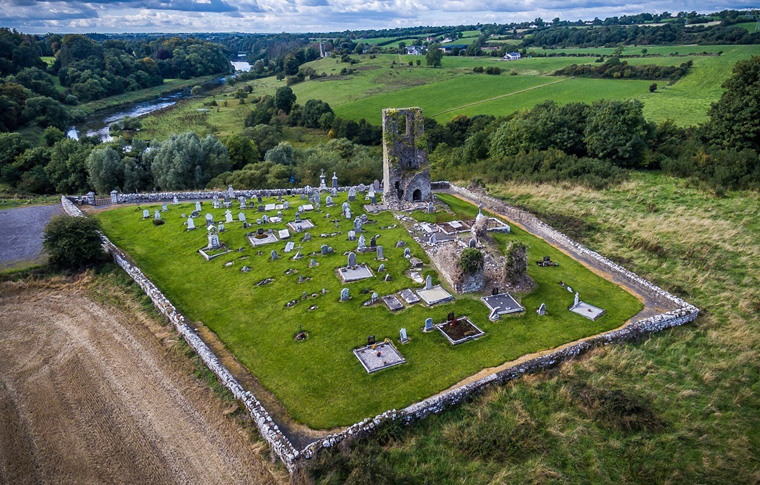 Ardmulchan - Aerial View.
The ruins of Ardmulchan Church stand on that elevated bank. At the west end rises a handsome square bell tower of three stories. The ground floor is almost intact: vaulted, with a mural stair and openings in the vault once used for bell ropes. Little of the nave and chancel survives beyond low walling and foundations, yet the tower alone makes the stop worthwhile. The church was dedicated to the Blessed Virgin Mary.
In the late 12th century this stretch of the Boyne was vital to the Norman colony in Meath. Hugh de Lacy, who conquered and held much of the valley, kept Ardmulchan in his own hands for a time. A substantial motte was raised on the height above the river, and a church with several chapels was rebuilt on earlier, pre-Norman foundations. The bell tower may belong to the 13th or 14th century. The scant remains of the church itself look largely 15th century, including fragments associated with a mullioned east window.
Before the close of the 12th century the manor passed to Theobald Walter le Botiller, who granted the church and its chapels to the Abbey of St Thomas the Martyr in Dublin. The living later left those monks and was linked with a convent at Lismullin. The manor itself returned to the de Lacys and later to the de Genevilles. By the mid-17th century the Civil Survey still recorded a castle, church, tuck mill, cottages, and a ford over the Boyne at Ardmulchan.
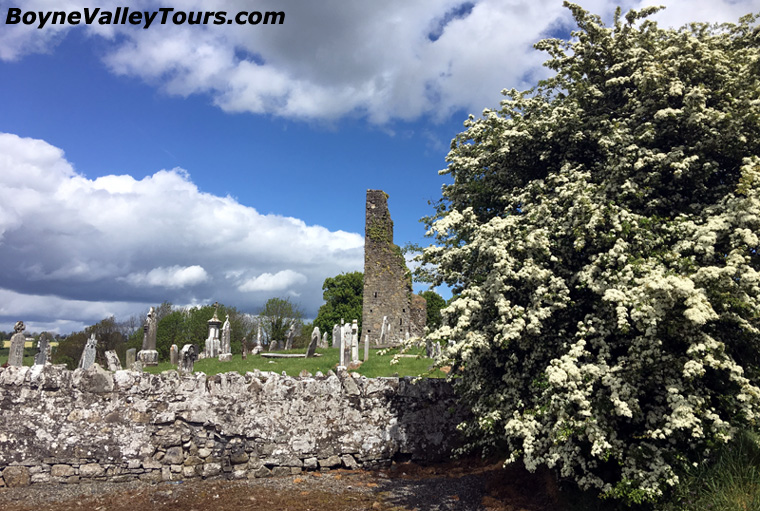 Hawthorn (White Thorn) in flower at Ardmulchan.
On the north side of the graveyard an overgrown Norman motte still marks the old defensive position. Within the rectangular, masonry-walled burial ground are many older memorials. Among them is a sandstone cross-slab bearing a raised ringed cross, and other graveslabs of interest survive in and around the ruined nave. Local tradition says that during the Reformation the church bell was thrown into a deep pool in the Boyne to keep it from plunderers.
The outlook from the ridge is one of the Boyne Valley's great landscape views. Across the fields you can pick out the ruins of Dunmoe Castle, the round tower at Donaghmore, and the belfry of Slane Abbey, all set among gently sloping green slopes. From the river below, the same ridge can also be seen from the Boyne Ramparts near Stackallen Bridge. Nearby, privately owned Ardmulchan House is a red-brick mansion of the early 1900s, built in a Scottish baronial style above the canal, with steps dropping toward the water. It is not open to the public, but it forms part of the historic setting around the church and Dunmoe.
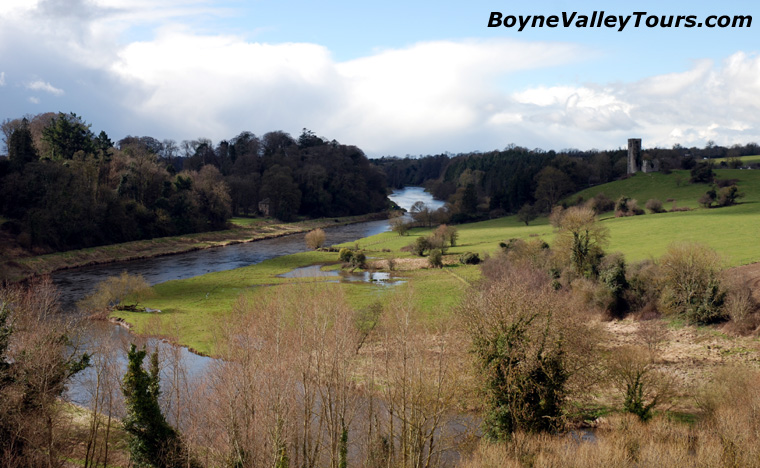 View of the River Boyne and Dunmoe Castle from Ardmulchan Church.
Dunmoe Castle
Just across the river, the ruins of 15th-century Dunmoe Castle hold a commanding view of the Boyne. It was the home of the D'Arcy family and stood on the edge of the English Pale. The castle came through the Cromwellian campaign of 1649 and the Williamite War of 1690, but fire destroyed it during the United Irishmen Rebellion in 1798. Seen from Ardmulchan, Dunmoe and the church ruins face each other across one of the most scenic reaches of the valley.
Ardmulchan makes a rewarding stop on a private Boyne Valley day tour with a driver-guide, especially when traveling between Navan, Slane, and the great monuments of Newgrange and Knowth. Your guide can place the church, motte, and river views in the wider story of the valley while you enjoy the scenery without navigating the quiet laneways yourself.
TripAdvisor Review
My son and I toured the Boyne Valley with Michael Fox. We visited Knowth and Newgrange, the Hill of Slane, the Hill of Tara and Ardmulchan. Michael was very professional throughout. Read the full TripAdvisor review