Garden Labyrinth
This seven-circuit classical labyrinth is a single grass path that winds to a standing stone at the center and back out again. It is not a maze. There are no dead ends, only a quiet walk for reflection in a Boyne Valley garden.
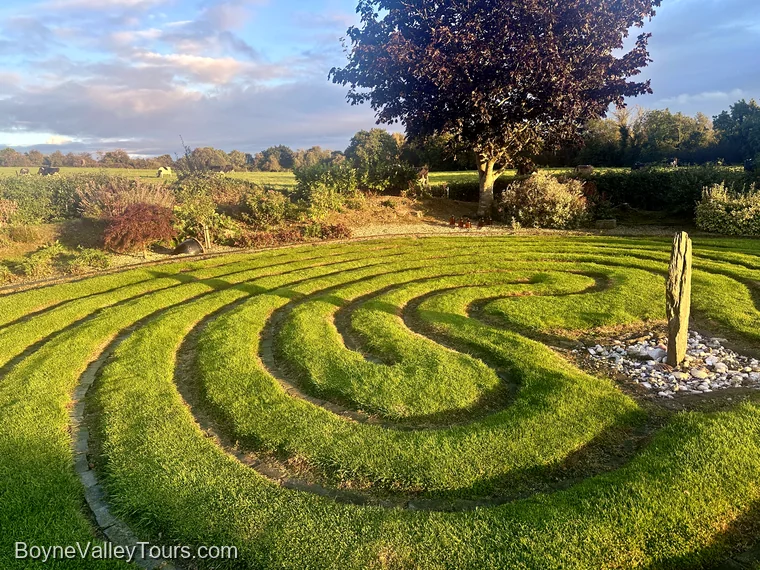 Sunset casting a long shadow across the labyrinth - September 2026.
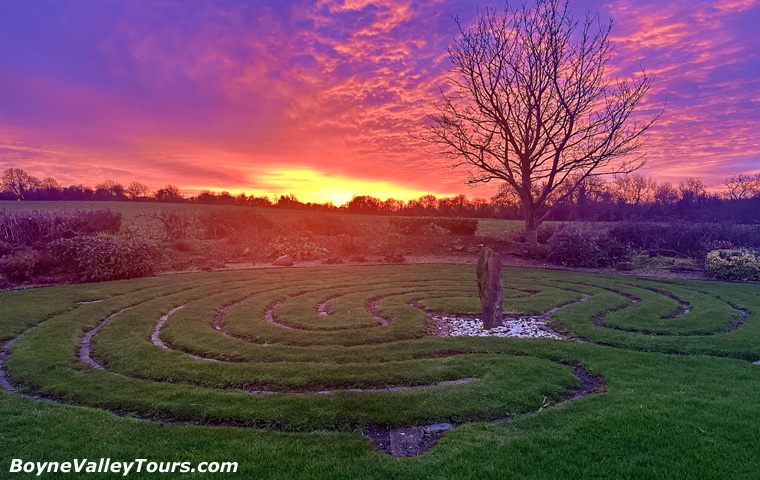 Winter Sunrise, January 2026.
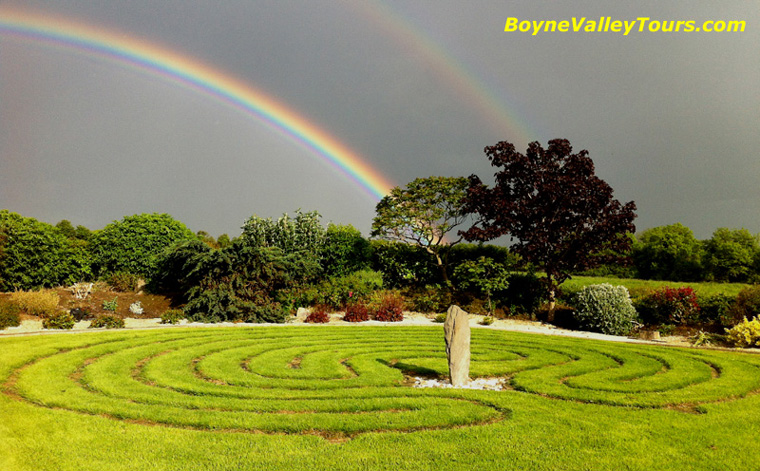 Double rainbow, March 2014.
This labyrinth is not taken from the spiral and other motifs in Boyne Valley megalithic art, yet it shares a similar quiet mood: a place you enter slowly, with attention.
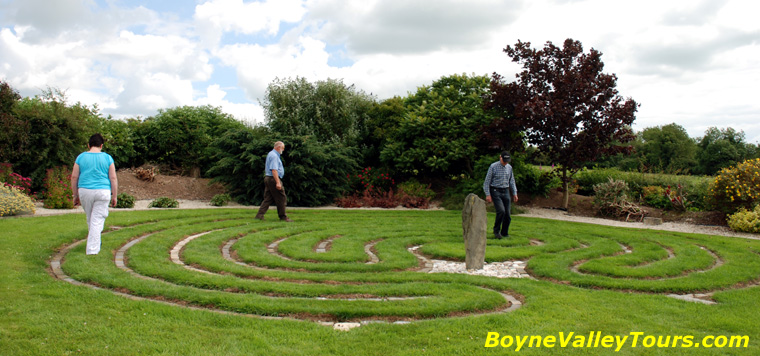 Labyrinth walkers, July 2011.
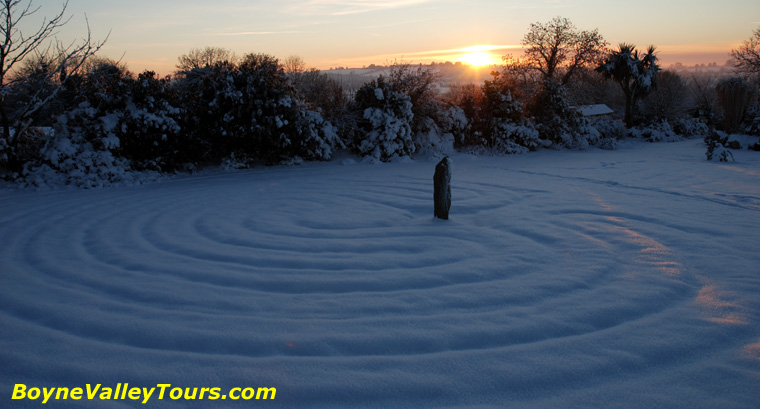 Garden Labyrinth, Sunset December 2010.
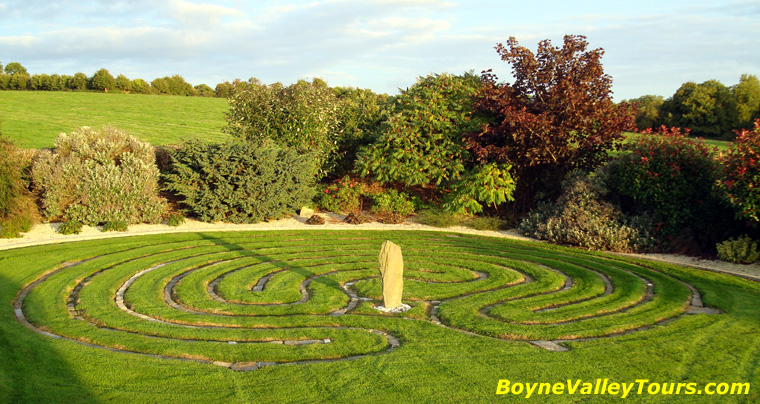 Long shadow from standing stone at equinox sunset in September 2010.
In Ireland, where the land itself is layered with memory, a labyrinth can be a quiet counterpoint to the great monuments of stone and earth. Passage tombs, standing stones, and hilltop enclosures were built to endure. A labyrinth is experienced through movement rather than scale.
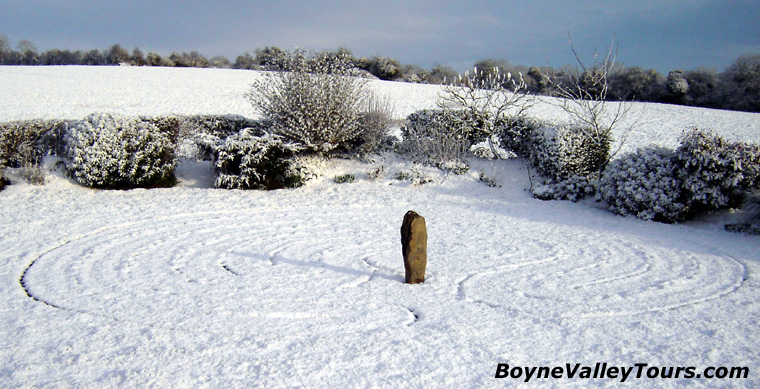 Standing stone installed in 2006.
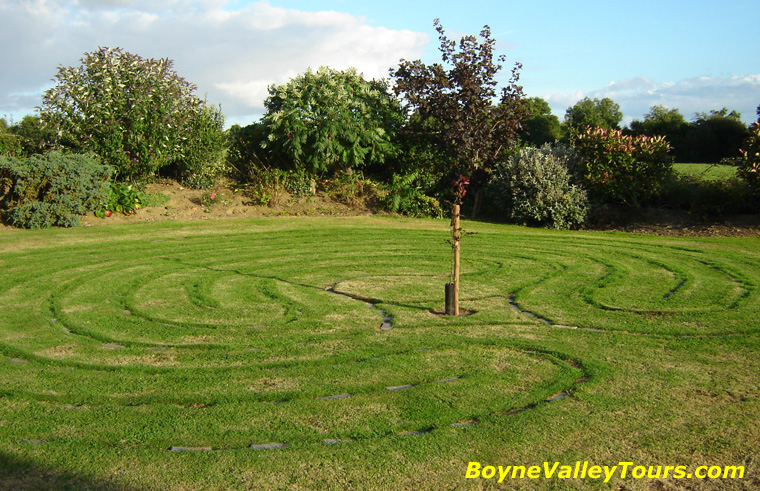 Labyrinth with paving stones buried in 2005.
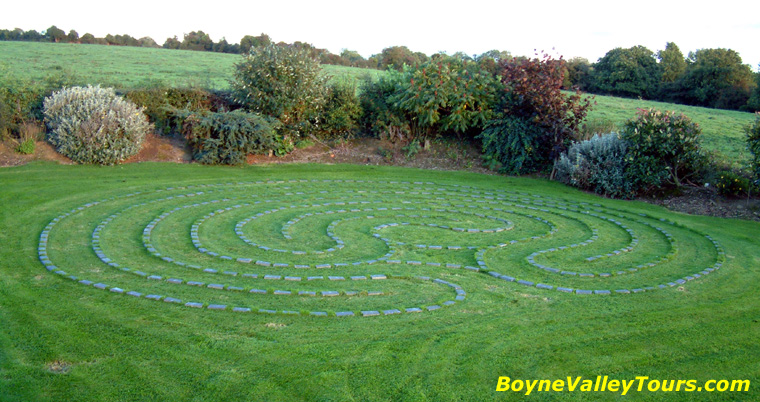 Labyrinth with paving stones laid on the grass in 2004.
The Seven-Circuit Classical Labyrinth
The Boyne Valley garden path follows the classical seven-circuit design, also called the Cretan pattern after its later link with the myth of Knossos. It is one of the oldest and most widespread labyrinth forms: a single path that loops through seven circuits to a center, then returns the same way.
Labyrinth, Not Maze
A maze is built to confuse. It offers choices, branches, and dead ends. A labyrinth has one route only. You cannot get lost. The interest lies in the journey itself: the changing direction of the path, the approach to the center, and the walk back out.
How the Design Is Built
The classical pattern is usually drawn from a simple seed: a cross, four right angles, and four dots. From that small diagram the full seven-circuit figure can be expanded, which helps explain how the same design appears in so many places without needing complex plans. Counted from the outside in, seven pathways surround the goal, bounded by eight walls or borders. The outline may be circular or square. This garden version is circular and laid in grass.
History and Spread
Versions of this design go back thousands of years. Related patterns appear on rock carvings, pottery, and other objects across Europe and far beyond, long before the Greek story of Daedalus, the Minotaur, and the Labyrinth of Crete became famous. On coins from Knossos from about the fifth to third centuries BC, the seven-circuit figure stood for that legendary labyrinth, even though the myth describes a branching prison and the drawn design is a single path.
Because the seed pattern is easy to remember, the classical labyrinth traveled widely. It shows up in historical contexts from the Mediterranean to northern Europe, North Africa, parts of Asia, and the Americas. Medieval Europe later favored more elaborate church labyrinths, such as the eleven-circuit Chartres type, yet the older seven-circuit form never disappeared and has returned strongly in modern garden and walking labyrinths.
Walking the Seven Circuits
On the ground, the path turns left and right as it works toward the center. You pass close to the middle early on, then sweep out again before arriving. Many walkers use that rhythm for quiet thought, prayer, or simply a break from hurry. The center is a pause. The return is part of the design: the same path leads you back to the entrance and the world beyond the circle.
TripAdvisor Review
Michael is a fabulous and extremely knowledgeable tour guide. Boyne Valley Tours is a wonderful way to see many historical sites of the Boyne Valley. Read the full TripAdvisor review