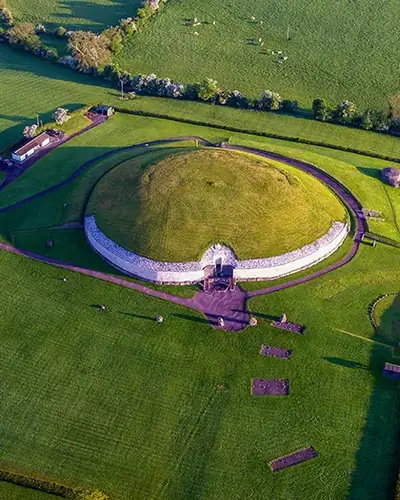
Knowth is a Neolithic passage tomb in the Boyne Valley and part of the Brú na Bóinne UNESCO World Heritage Site.
Its great mound was originally edged by 127 kerbstones, many carved with spirals, circles, zigzags, and other abstract motifs.
This page looks at Kerbstone K93, one of Knowth's decorated kerbstones.
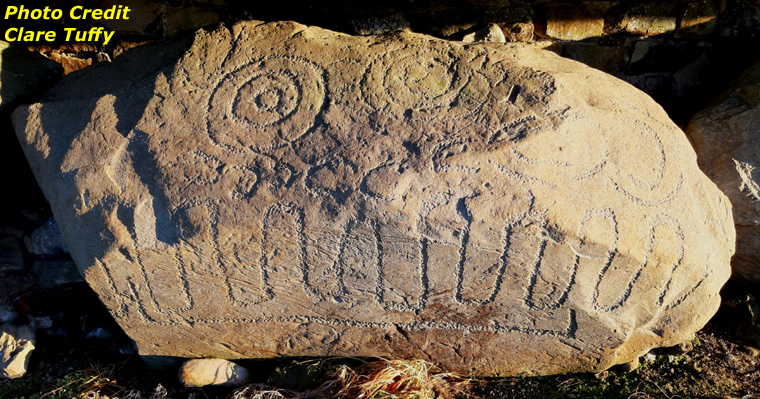
Knowth Kerbstone K93.
The stone has a distinct horizontal arris, and the carvings on the upper part are noticeably more weathered than those lower down.
The main motif is an eighteen-bend serpentiform that runs across the stone, beneath which is a horizontal line that turns upward
at each end. Above the serpentiform is a row of six single arcs, with two double arcs and one single arc further to the right. All of the arcs open to the same side.
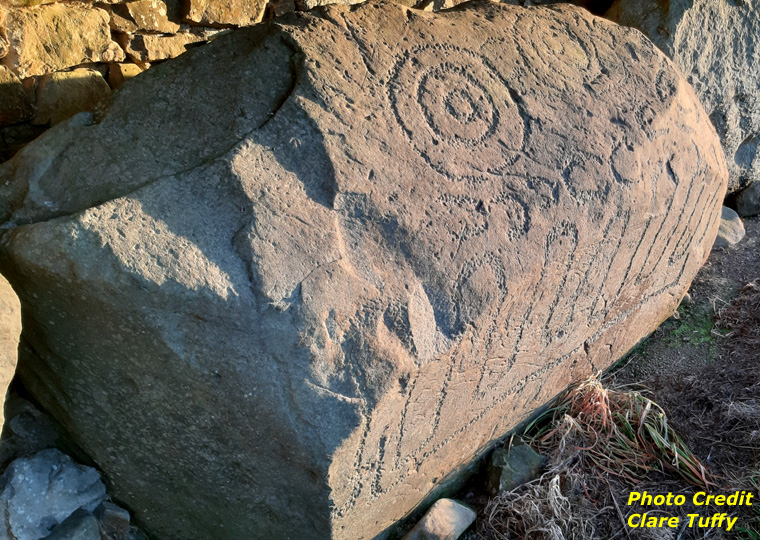
Knowth Kerbstone K93.
Above these motifs, starting from the left, is a double concentric circle, followed by a set of three concentric circles. Between this motif and the next to the right there may once have been a circular design. There are also traces of short, curved lines that may have formed part of an earlier motif. The next motif to the right is an anticlockwise spiral that turns back on itself, with several short lines and curves immediately to its right. The carvings on the upper slope of the stone were picked with a small to medium-sized point, while those on the lower part were worked with a medium-to-large point. In addition, some elongated marks were made using a chisel.
K93 is on the northwestern kerb and ranks among the most richly carved stones at Knowth.
The horizontal ridge across the stone divides an upper panel, where weathering has softened the lines, from clearer carvings below.
Some researchers see lunar themes in compositions like this one, with serpentiforms and rows of arcs that may reflect careful observation of the night sky.
Knowth holds roughly a quarter of all recorded megalithic art in western Europe.
The Brú na Bóinne passage tombs were designated a UNESCO World Heritage Site in 1993, recognizing the age, scale and artistry of monuments like this one.
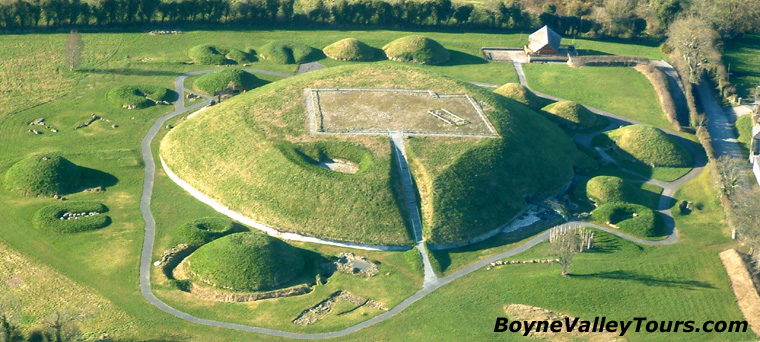
Knowth Passage Tomb Aerial View.
Further Reading
The definitive guide to Knowth's carved stones is
Excavations at Knowth Volume 7: The Megalithic Art of the Passage Tombs at Knowth, Co. Meath,
edited by Professor George Eogan and Dr Elizabeth Shee Twohig and published as part of the Excavations at Knowth series.
It is the official record of megalithic art from decades of excavation at Brú na Bóinne.
Kerbstone K93 receives a full treatment in the catalogue, covering its serpentiform, rows of arcs, concentric circles and anticlockwise spiral across the upper and lower panels of the stone.
Knowth was built around 3200 to 2900 BC, and this volume covers one of the site's most remarkable features: its carved stones.
All 390 decorated kerbstones, passage stones and chamber stones are catalogued with written descriptions, line drawings and photographs.
Six main art styles are identified and explained, along with the motifs and carving techniques the Neolithic builders used.
Knowth accounts for about 46 percent of all passage tomb art in Ireland and roughly a third of the megalithic art recorded in Europe.
The book also places Knowth in a wider context, comparing its carvings with those at other Irish tombs, sites in western and northern Britain,
and earlier megalithic art across Atlantic Europe.
If you have walked the kerb at Knowth and want to understand what you saw, this is the reference to keep.
Ideal for a first visit to the Boyne Valley, this private tour explores the UNESCO World Heritage landscape of Brú na Bóinne.
Visit Newgrange and Knowth with the official site guides,
then discover places associated with Ireland's ancient kings, mythology, and Saint Patrick.
The day also includes the Hill of Slane and the Hill of Tara.
Price €700 for up to six guests, plus booking fees. Admission fees are extra.
Michael was a terrific host for our day in the Boyne Valley. He had our tour very well planned. We saw lots of sites, but he left things open for us to choose. At no point did we feel rushed.
Read the full TripAdvisor review