Fore Abbey
Fore Abbey sits in a quiet green valley in the village of Fore, County Westmeath, about a 30 minute drive from Mullingar and roughly 4 km (2.5 miles) from Castlepollard. The place name comes from the Irish Fobhar, meaning water springs, a reminder of the wells and underground streams that still shape the site.
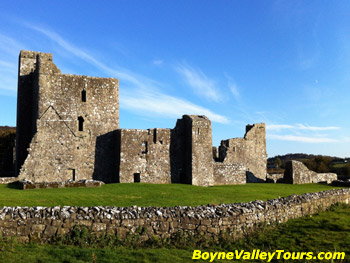 Fore Benedictine Abbey, County Westmeath.
Saint Feichin (also written Féchín or Fechin) is said to have founded a monastery here around AD 630. Heritage Ireland notes that before his death the community may have numbered about 300 monks.
In the later twelfth and thirteenth centuries the de Lacy lords of Meath refounded Fore as a Benedictine priory. The priory was dedicated to both Saint Feichin and Saint Taurin of Évreux in Normandy, linking this Westmeath valley to a wider European monastic network. Much of what visitors walk through today dates from the thirteenth and fifteenth centuries: church, cloister ranges, gatehouse, and later defensive work. Fore is widely regarded as Ireland's best surviving medieval Benedictine complex.
The early monastery was raided and burned many times. Local and tourist accounts often mention twelve fires across the centuries of conflict that followed. Even so, Fore kept a reputation for learning. Later writers remembered the settlement as Baile Leabhair, the Town of Books.
What you will see
On the higher ground stands St Feichin's Church, usually dated to around AD 900, with its famous heavy lintel over the west doorway. Down in the valley floor lie the Benedictine ruins: cruciform church, cloister, domestic ranges, and a circular dovecote. Nearby are the mill site associated with the saint's water legends, holy wells, and the anchorite's cell on the slope above the churches. A Nugent family mausoleum was later added to that tower-like cell, so the structure can look almost like a small church from some angles.
Around the wider Fore landscape are about 18 wayside crosses, spread across roughly 10 km (6 miles) of roadways and fields. They are a good reason to slow down and treat the whole valley as one historic setting rather than a single ruin in a car park.
The Seven Wonders of Fore
Local tradition groups seven unusual features as the Seven Wonders of Fore. Some have natural explanations in the hydrology of Lough Lene and the valley bog. Others belong to legend. Together they are still the stories most visitors come to hear.
The monastery built upon the bog | the later Benedictine abbey stands on marshy ground in the valley floor.
The mill without a race | tradition says Saint Feichin struck the ground with his crozier and water appeared to drive the mill.
The water that flows uphill | underground flow from the Lough Lene side can look as if it is rising toward the mill.
The tree that won't burn | remembered as an ash with three branches for the Trinity. Pilgrims later pressed coins into a copper tree near the wells.
The water that doesn't boil | the water of St Feichin's well, long treated as a place of healing and prayer.
The anchorite in a cell | hermits once occupied the stone cell above the churches.
The lintel stone raised by St Feichin's prayers | the great doorway lintel of St Feichin's Church.
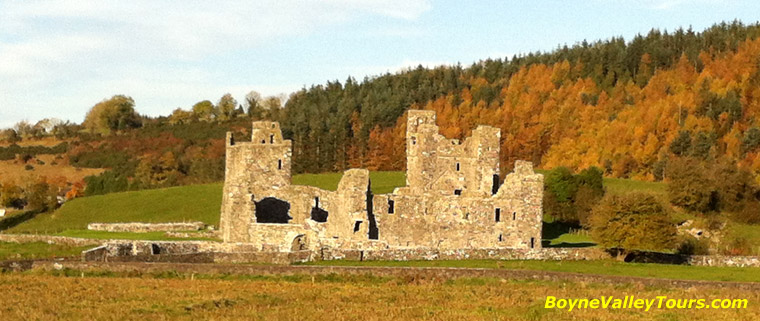 Fore Benedictine Abbey in the valley below the village.
St Feichin's Way
The best way to understand Fore is on foot. St Feichin's Way is a looped walk of about 3 km (1.9 miles) around the monastic landscape, taking in the abbey ruins, wells, woodland stretches, and other points of interest. Visit Westmeath and Discover Ireland both recommend it as the natural route through the Seven Wonders and the surrounding valley. Allow around 45 to 60 minutes at an easy pace, longer if you stop for photographs or the fairy trail section through the trees.
Planning a visit
Fore Abbey is in the care of the Office of Public Works and is listed by Heritage Ireland. It is generally open all year, with free admission and no ticket office or timed entry. There is a car park by the site, with coach parking noted among the facilities. A coffee shop near the entrance serves drinks and light food when open.
Paths can be uneven, muddy, or slippery after rain, so sturdy footwear and weatherproof clothing are sensible. Access for visitors with reduced mobility is restricted in places. The eircode used by Heritage Ireland for the site is N91 TN92.
Fore sits in Ireland's Hidden Heartlands as well as within easy touring distance of Ireland's Ancient East. Nearby Loughcrew Cairns make a natural pairing for a Westmeath and Meath day that mixes early Christian ruins with hilltop passage tombs. From Fore you can also continue toward the Boyne Valley for Trim Castle, the Hill of Tara, or the passage tombs at Newgrange and Knowth.
Fore as an early monastic landscape
Fore was never just one building. Springs, wells, churches, and later cloister ranges all belong to the same sacred valley. In early Irish Christianity, water places often carried ideas of healing and spiritual power, and that helps explain both the foundation story and the later wonders. Saint Feichin is also linked with foundations at Omey Island, Cong, and Termonfeckin, so Fore sits in a wider seventh century monastic map rather than standing alone.
Norman priory and later centuries
The Benedictine refoundation brought continental monastic planning to the valley: church to one side of a cloister, dormitory and chapter ranges, refectory and kitchen, and later towers and walls that speak of unsettled times. As a cell connected with a house in Normandy, Fore could be treated as an alien priory when England and France were at war, another reminder that this quiet place was tied into bigger medieval politics. After the dissolution of the monasteries the site passed out of religious use, but the ruins, wells, and local stories remained central to Fore's identity.
Fore Abbey Today
Today Fore remains one of the most atmospheric monastic stops west of the Boyne Valley. It is quieter than many headline abbeys, with room to walk the ruins, follow the looped path, and take in the springs and folklore that still define the place.
TripAdvisor Review
Michael Fox is an amazing guide and cultivated an experience we will never forget. In eight hours we saw multiple Neolithic sites including Newgrange, and he collaborated easily so we got to see what mattered most. Read the full TripAdvisor review