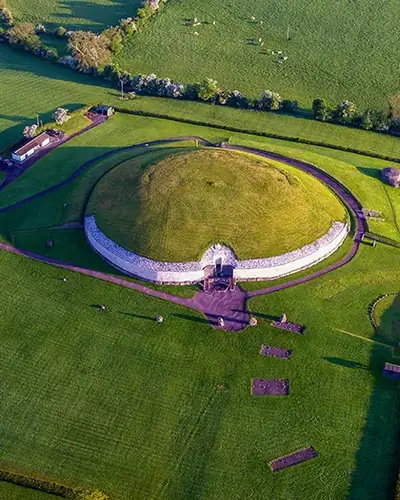
Knowth is a Neolithic passage tomb in the Boyne Valley and part of the Brú na Bóinne UNESCO World Heritage Site.
Its great mound was originally edged by 127 kerbstones, many carved with spirals, circles, zigzags, and other abstract motifs.
This page looks at Kerbstone K91, one of Knowth's decorated kerbstones.
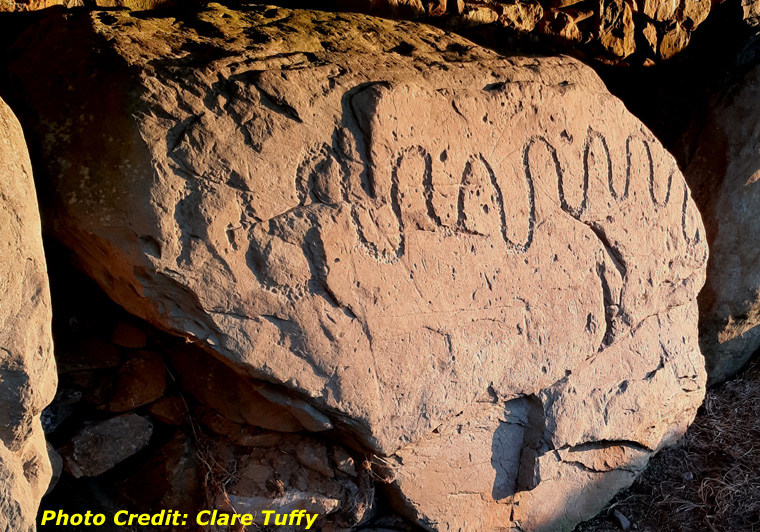
Knowth Kerbstone K91.
The stone is greywacke, a type of sandstone composed of tightly cemented mineral grains and rock fragments.
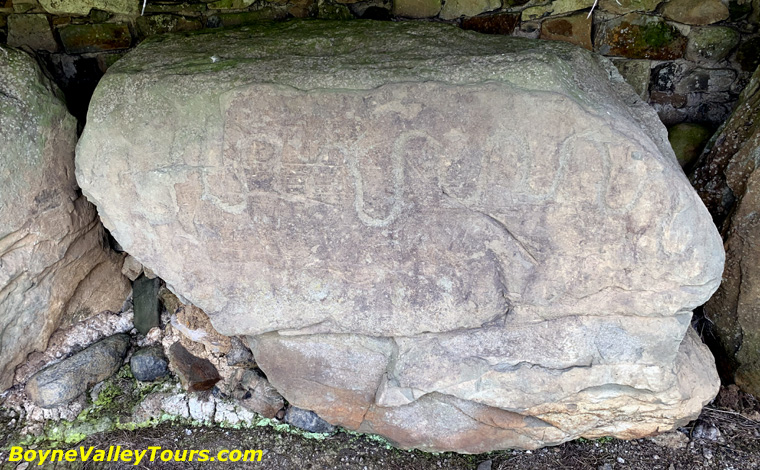
A single serpentiform motif with seventeen bends is picked across the stone using a variety of rounded points. At the right end, the motif curves downward briefly along the edge of the stone.
K91 is on the northwestern kerb, part of the ring that defines the oval footprint of the great passage tomb.
Serpentiforms, wavy lines that snake across the stone face, are a distinctive Knowth motif, and K91 is one of the clearest examples on the mound.
Warm side light, as in the photograph above, often makes the carving easier to see than on an overcast day.
K91 contributes to the largest open-air gallery of Neolithic art in western Europe.
When you visit Knowth, allow time to walk the full kerb circuit; the art is spread around the entire base of the mound rather than concentrated at the entrance alone.
Knowth Kerbstone K91.
Further Reading
The definitive guide to Knowth's carved stones is
Excavations at Knowth Volume 7: The Megalithic Art of the Passage Tombs at Knowth, Co. Meath,
edited by Professor George Eogan and Dr Elizabeth Shee Twohig and published as part of the Excavations at Knowth series.
It is the official record of megalithic art from decades of excavation at Brú na Bóinne.
Kerbstone K91 is recorded as a single serpentiform with seventeen bends, one of the clearest wavy-line motifs on the Knowth kerb.
Knowth was built around 3200 to 2900 BC, and this volume covers one of the site's most remarkable features: its carved stones.
All 390 decorated kerbstones, passage stones and chamber stones are catalogued with written descriptions, line drawings and photographs.
Six main art styles are identified and explained, along with the motifs and carving techniques the Neolithic builders used.
Knowth accounts for about 46 percent of all passage tomb art in Ireland and roughly a third of the megalithic art recorded in Europe.
The book also places Knowth in a wider context, comparing its carvings with those at other Irish tombs, sites in western and northern Britain,
and earlier megalithic art across Atlantic Europe.
If you have walked the kerb at Knowth and want to understand what you saw, this is the reference to keep.
Ideal for a first visit to the Boyne Valley, this private tour explores the UNESCO World Heritage landscape of Brú na Bóinne.
Visit Newgrange and Knowth with the official site guides,
then discover places associated with Ireland's ancient kings, mythology, and Saint Patrick.
The day also includes the Hill of Slane and the Hill of Tara.
Price €700 for up to six guests, plus booking fees. Admission fees are extra.
We were so fortunate to spend a day with Michael Fox. He is a delightful person, an excellent guide, and he goes above and beyond to ensure you have a fabulous experience.
Read the full TripAdvisor review