Loughcrew Equinox
Access to Loughcrew Cairn T
Cairn T has been closed to the public since October 2018. There is currently no access to the interior of the chamber on equinox mornings. Visitors may still gather outside the cairn to watch the sunrise.
On the mornings around the spring equinox and the autumn equinox on Carnbane East at Loughcrew, the rising sun illuminates the passage and chamber of Cairn T. The sunlight is shaped by the stones of the entrance and passage and descends the backstone while moving from left to the right illuminating the solar symbols.
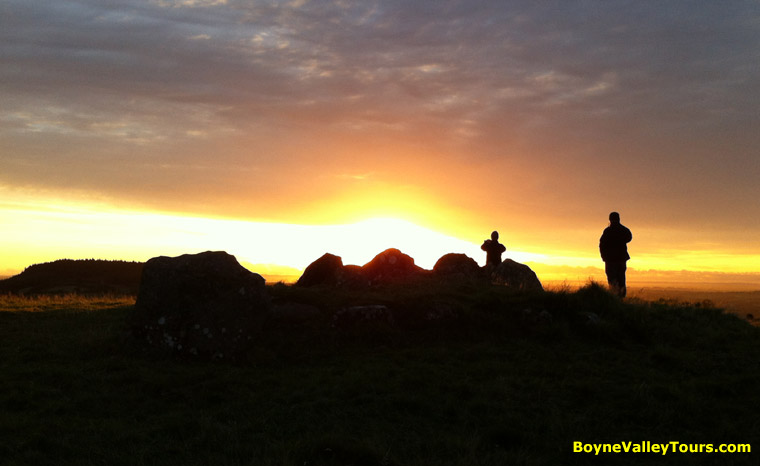 Equinox sunrise on Carnbane East at Loughcrew,.
Twice a year, around 21 March and 21 September, people gather on the hill before dawn. If the sky is clear, sunlight still enters Cairn T for about an hour after sunrise and illuminates the chamber. The same sequence happens at both the spring and autumn equinoxes, and visitors watch it from outside.
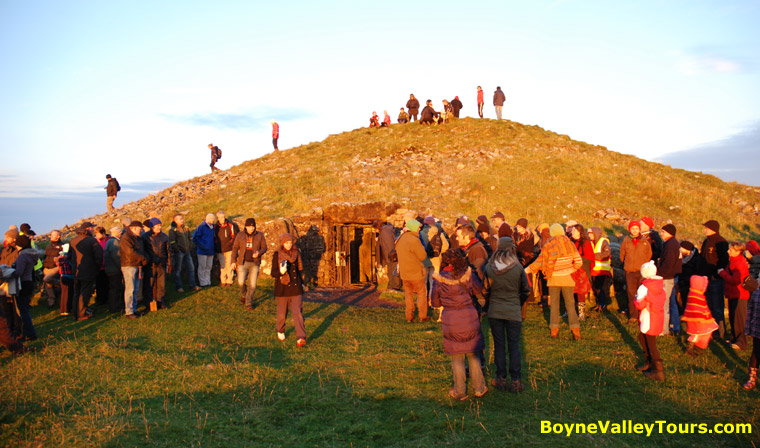 Archive photograph: visitors waiting to enter Cairn T for the equinox illumination, taken when the chamber was still open.
When the chamber was open, Cairn T was one of the few Irish passage tombs where this effect was easy to watch from inside. The chamber is small, so visitors went in in short groups. The art on the backstone is easier to read when the sun picks it out than it is in torchlight. That may be why the stones were placed as they are, to mark the time of the year in a way that could be seen, not only measured. The interior of Cairn T is currently closed for conservation work, and equinox gatherings now take place outside the cairn.
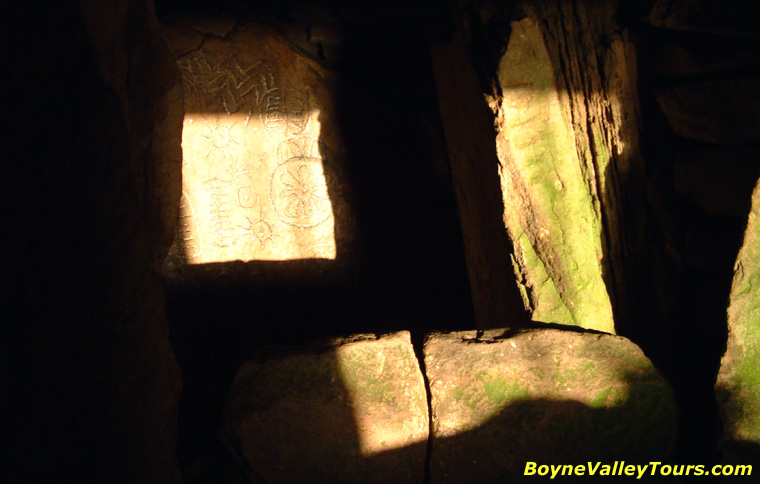 Archive photograph: equinox sunbeam in the chamber of Loughcrew Cairn T, taken when the interior was still open.
Autumn Equinox 2016
Loughcrew Video - Spring Equinox 2005
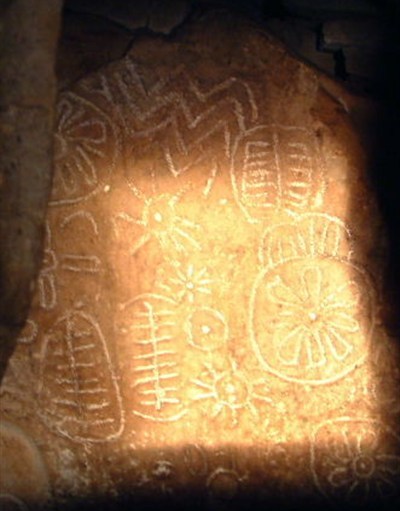 Archive photograph: equinox sunlight on the backstone in Cairn T, taken when the chamber was still open.
Loughcrew Equinox Archive
- March 2014 Spring Equinox.
- September 2012 Autumn Equinox.
- September 2011 Autumn Equinox.
- March 2010 Spring Equinox.
- September 2009 Autumn Equinox.
- March 2009 Spring Equinox.
- September 2008 Autumn Equinox.
- September 2008 Autumn Equinox.
- March 2008 Spring Equinox.
- September 2007 Autumn Equinox.
- September 2006 Autumn Equinox.
- September 2005 Autumn Equinox.
- March 2005 Spring Equinox.
- March 2005 Equinox Video.
- September 2004 Autumn Equinox.
- March 2004 Spring Equinox.
- September 2002 Autumn Equinox.
TripAdvisor Review
Michael Fox is an expert in all things Boyne Valley. From the moment he picked us up at our hotel to depositing us back there at the end of the day, we were entranced by the entertaining historical facts. Read the full TripAdvisor review