Slane Castle Distillery
Slane Castle Irish Whiskey began as a family project. Lord Henry Mount Charles and his son, Alex Conyngham, launched the brand in 2009, initially working with Cooley Distillery to produce the whiskey. Their ambition was to bring whiskey-making back to the Slane estate and create a spirit closely connected with the castle, the village, and the wider Boyne Valley.
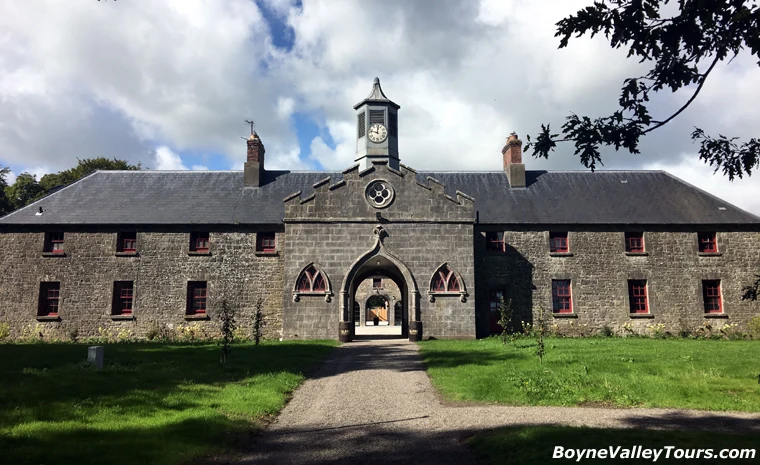 Slane Castle Distillery.
The Conynghams later set out to produce whiskey on the estate itself. Plans were developed to transform the mid-18th-century stable yards beside the castle into a working distillery and visitor center. Planning permission was granted by Meath County Council in 2013, with the new production buildings carefully positioned behind the Georgian stables to preserve their historic character.
In 2015, Kentucky-based Brown-Forman, the company behind Jack Daniel's, purchased Slane Castle Irish Whiskey Limited. This investment helped bring the family's plans for the distillery and visitor experience to completion, and the distillery opened to visitors in 2017.
Slane Irish Whiskey is triple-distilled and matured using a signature triple-casked method, combining virgin American oak, seasoned Tennessee whiskey barrels, and Spanish oloroso sherry casks. This combination contributes notes of spice, vanilla, and dried fruit to the house blend. Additional expressions, including releases with a stronger sherry-cask influence, broaden the range.
The signature guided experience explores the historic stable buildings and working distillery before concluding with a tasting of Slane Irish Whiskey. Additional experiences offer more detailed tastings and a closer look at the influence of the three cask types used in the signature blend. Advance booking is recommended, and all whiskey experiences are restricted to guests aged 18 or older.
The Conyngham family remains central to the story of the brand. Alex Conyngham, now Marquess Conyngham, continues his involvement as co-founder and global ambassador, maintaining the whiskey's close connection with the estate as the brand reaches international markets.
Boann Distillery
Boann Distillery is located just outside Drogheda, close to the M1 and approximately one hour from Dublin. It is named for Boann, the goddess linked in legend with the creation of the River Boyne. The distillery brought whiskey-making back to a town that once had several small distilleries, the last of which closed in the mid-19th century.
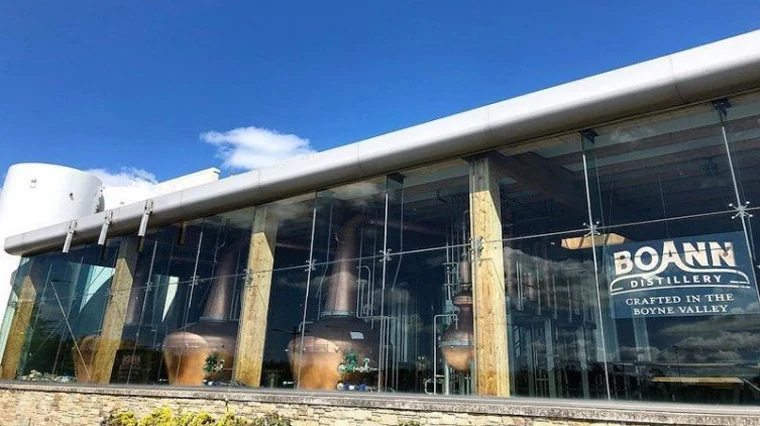 Boann Distillery.
The business is independent and family-run. Pat and Marie Cooney founded it with their children after decades in the Irish drinks trade, including building up the Gleeson Group before its sale. They chose a former car showroom site at Lagavooren and fitted it out as a modern distillery, with tall Italian-made copper pot stills visible through the glass. The stills incorporate nano-copper technology in their lyne arms, increasing contact between the copper and spirit vapor to help refine the new-make spirit.
Boann specializes in single pot still Irish whiskey, using mixed-grain mash bills that can include malted and unmalted barley, as well as oats, wheat, or rye. These styles were once common in Ireland and are now being revived. Water is drawn from a Boyne Valley well, and grain is sourced from Irish farmers. Alongside the Boann range, the family produces the Whistler whiskey line, named with a nod to Pat Cooney himself, plus craft gins such as Silks, inspired by the jockey silks at nearby Bellewstown races.
Guided tours and tastings are currently offered on Fridays at 3:00 p.m., and advance reservations are recommended. A visit pairs well with Drogheda, Mellifont, Monasterboice, or a private Boyne Valley day tour.
Pat Cooney, who led the project as CEO of the distillery and visitor experience, said:
"I've been in the drinks industry for the past 40 years and it has been a nagging ambition to establish a distillery of my own. To be able to realize this ambition, with the encouragement and participation of my wife and family, is a great bonus and to be able to establish this project in this super building in my home town is a multiple bonus. The location in the Boyne Valley is a very valuable asset and we hope to play our part in promoting the tourist potential for this major attraction and Ireland's East Coast."
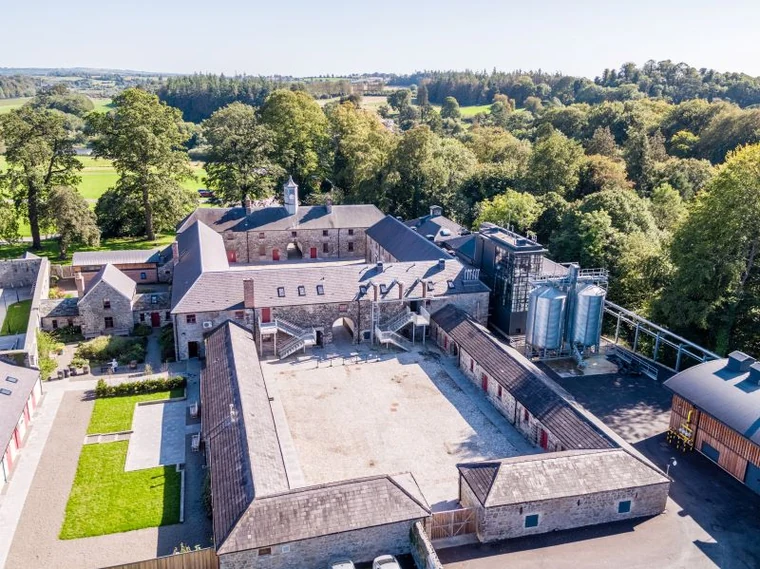 Aerial view of Slane Castle Distillery.
From Uisce Beatha to a Boyne Valley Whiskey Revival
The Boyne Valley is best known for ancient monuments, medieval castles, and the River Boyne, but it also has a fascinating history of brewing and distilling. Drogheda was once one of Ireland’s most active distilling towns, while historic records also identify distilleries in Navan. Today, Boann Distillery and Slane Distillery are bringing whiskey production back to the region.
The Origins of Irish Whiskey
The precise origins of distilling in Ireland are uncertain, although the craft is generally believed to have developed during the medieval period. Distillers adapted techniques used elsewhere in Europe and worked with locally available cereal grains rather than grapes.
The resulting spirit became known as uisce beatha, the Irish term for “water of life.” Over time, the anglicized pronunciation of uisce evolved into the word “whiskey.”
Drogheda has an important place in this early history. An Act of Parliament passed in the town in 1556 restricted the production of aqua vitae to peers, gentlemen, freemen of larger towns, and those holding an official license. Although this was intended to regulate distilling rather than encourage it, the legislation provides valuable evidence that spirit production was already well established in 16th-century Ireland.
Drogheda’s Eighteen Distilleries
Drogheda’s location helped it develop into an important center of commerce and industry. The River Boyne provided water and power, while the port connected local merchants with markets in Ireland, Britain, Europe, and farther afield. The surrounding countryside supplied grain, and the town had the commercial skills needed to produce, store, and distribute whiskey.
According to the historical account published by Boann Distillery, Drogheda had no fewer than eighteen distilleries in 1774. These varied considerably in size, and not all survived the economic and regulatory changes that transformed the Irish whiskey industry. By 1822, the number had declined to one.
Drogheda also supported related trades. Whiskey production required millers, maltsters, coopers, warehouse workers, carters, merchants, and agricultural laborers. Distilling was therefore part of a much wider local economy rather than an isolated industry.
James Woolsey and Drogheda’s Last Working Distillery
The last surviving Drogheda distillery was owned by James Woolsey and became one of Ireland’s more important whiskey producers. Its buildings stood near Dyer Street and Wellington Quay, close to the River Boyne and the commercial center of the town.
The distillery ceased production during the 1850s, bringing more than a century of documented commercial distilling in Drogheda to an end. Archaeological work undertaken near Dyer Street in 1999 uncovered foundations belonging to 19th-century storerooms associated with the distillery. The buildings are also shown on the 1870 Ordnance Survey map of Drogheda.
Preston Brothers and the Whiskey-Bonding Tradition
Although distilling had ended, the former distillery site remained connected with whiskey. In 1886, the Preston brothers acquired the empty buildings and established a whiskey-bonding business.
Whiskey bonders purchased spirit from working distilleries and matured it in their own casks and warehouses. They could then bottle and sell the matured whiskey under their own name. Preston Brothers bonded spirit produced at the Jameson distillery on Bow Street in Dublin, and Preston’s Whiskey became closely associated with Drogheda.
The Preston business was later acquired by the Cairnes family of Drogheda’s well-known brewery. It subsequently became part of Grants of Ireland. In 1968, the remaining barrels were removed from Drogheda and transferred to Dublin, ending the town’s direct connection with whiskey maturation and bonding for more than half a century.
Whiskey Distilling in Navan
Drogheda was the Boyne Valley’s principal distilling center, but whiskey was also produced farther upstream. The Meath Industrial Heritage Survey records two early 19th-century distilleries in Navan.
One stood at Mill Lane on the north bank of the River Blackwater, close to its meeting point with the Boyne. A large mill had been constructed there in 1783 by Messrs. Connolly, Clarke, and Fay. After that enterprise closed, James Morgan developed a new mill and distillery on the site by 1836.
Historic Ordnance Survey maps identify the buildings as a mill and distillery. The complex was later adapted for other industries, including flax processing and furniture manufacturing. Although little of its distilling equipment survived, the site demonstrates how closely whiskey production was connected with rivers, grain milling, and the industrial development of Boyne Valley towns.
Meath County Council’s industrial heritage research found only two documented early 19th-century distilleries in the county, both in Navan. Breweries were also recorded in Kells and Trim, illustrating the wider importance of grain-based drink production throughout County Meath.
The Golden Age and Decline of Irish Whiskey
Drogheda and Navan formed part of a much larger Irish whiskey industry. The early 19th century was a period of remarkable expansion, with the number of licensed Irish distillers growing from approximately 40 in 1823 to 86 in 1840. Between 1823 and 1900, the output of Ireland’s distilleries quadrupled.
Dublin’s major distilleries, including Jameson, George Roe, and Powers, employed hundreds of workers and operated their own cooperages, stables, blacksmith shops, and carpentry workshops. Irish whiskey was exported around the world, and many Irish producers adopted the spelling “whiskey” with an “e” to distinguish their products in international markets.
By 1900, Ireland was a world leader in whiskey production. However, the industry soon entered a prolonged period of decline. Competition from blended Scotch whisky, economic recession, World War I, the Easter Rising, the Irish War of Independence, and the Civil War all caused disruption.
Prohibition closed the crucial United States market, while poor-quality spirits sold under Irish names by bootleggers damaged the product’s reputation. A trade dispute between the Irish government and Great Britain during the 1930s further restricted exports.
By 1953, only six distilleries remained on the island of Ireland. Consolidation continued, and Jameson, Powers, and Cork Distilleries merged to form Irish Distillers in 1966.
A Living Boyne Valley Whiskey Story
The whiskey history of the Boyne Valley is not confined to bottles and brand names. It is also a story of rivers, grain fields, mills, warehouses, merchants, craftspeople, and changing international markets.
In Drogheda, archaeological remains preserve traces of the Woolsey and Preston enterprises. In Navan, the former Mill Lane distillery recalls the town’s industrial relationship with the Boyne and Blackwater rivers. At Slane and Boann, working stills have restored whiskey production to a landscape where the craft once played an important economic and cultural role.
A private Boyne Valley tour can combine this distilling heritage with places such as Slane Castle, the Hill of Slane, Drogheda, Monasterboice, Mellifont Abbey, and the ancient monuments of Newgrange and Knowth. Distillery visits and tastings require advance planning and are subject to availability.
TripAdvisor Review
We did a full tour of Boyne Valley with Michael. He planned the day quite well, and we made it to all our sights and then some. Highlights included Slane Distillery, Dowth and the Hill of Tara. Read the full TripAdvisor review